1. Introduction
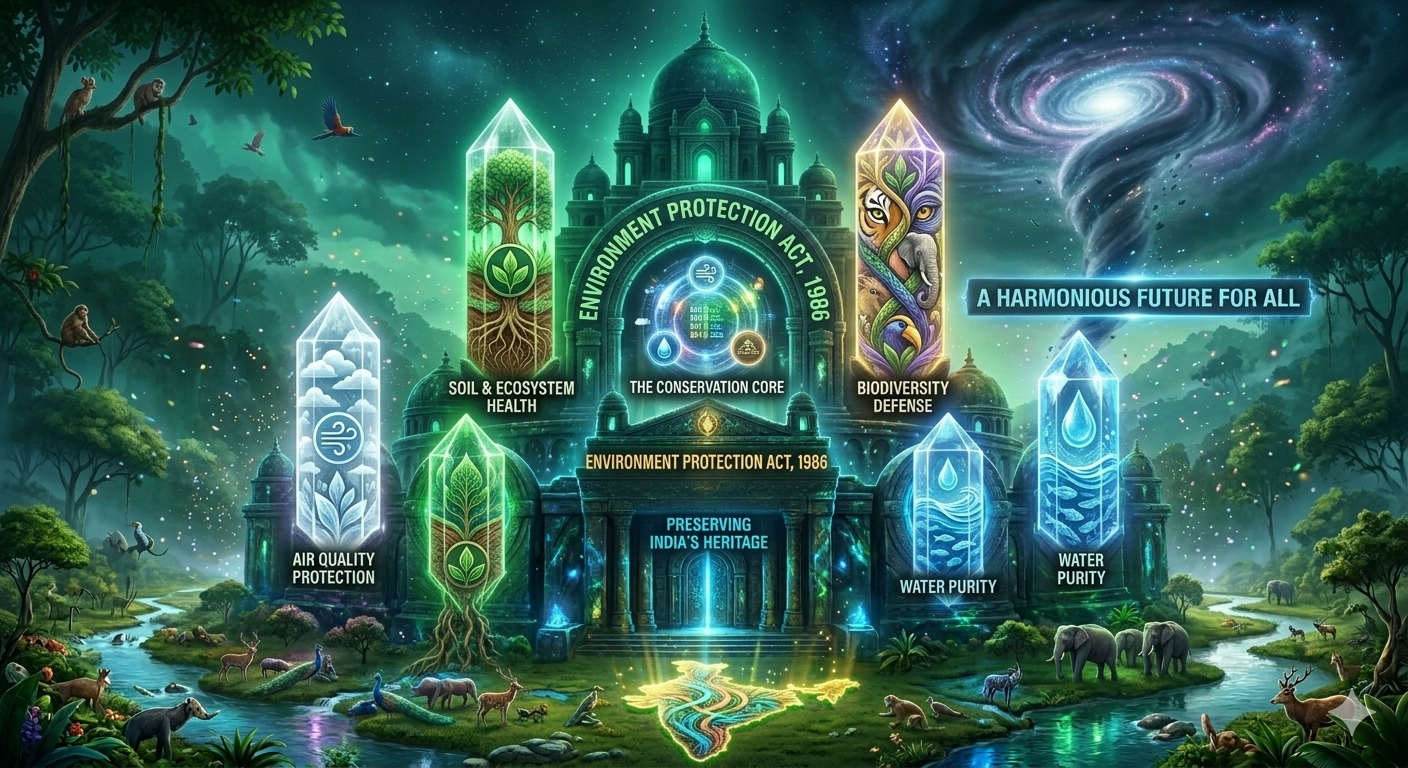
The Environment Protection Act (EPA), 1986 is a landmark legislation enacted by the Government of India following the Bhopal Gas Tragedy of 1984, one of the world’s worst industrial disasters. Recognizing the urgent need for a comprehensive legal framework to protect the environment, the Act was passed under Article 253 of the Indian Constitution, empowering the central government to implement measures to protect and improve environmental quality.
The EPA serves as an umbrella legislation, providing a framework to address environmental issues including air, water, and soil pollution, hazardous waste management, and the regulation of industrial activities. It also enables the government to formulate rules, standards, and penalties to ensure environmental protection.
Understanding the main provisions of the EPA is crucial for policymakers, students, environmentalists, and industries, as it outlines the legal responsibilities, authorities, and mechanisms to safeguard India’s environment.
2. Objectives of the Environment Protection Act
The EPA was enacted with the following key objectives:
- Protection and improvement of the environment through preventive and corrective measures.
- Regulation of industrial and developmental activities that may cause environmental degradation.
- Control of hazardous substances, waste, and pollutants to prevent ecological harm.
- Empowering the central government to enforce environmental laws, set standards, and coordinate with states.
- Promotion of sustainable development, balancing economic growth with environmental sustainability.
3. Scope and Applicability
The EPA is comprehensive in scope, covering all aspects of environmental protection in India. Its applicability includes:
- Air, water, and soil quality maintenance.
- Industries, factories, and developmental projects impacting the environment.
- Handling, storage, transport, and disposal of hazardous substances.
- Environmental impact assessments for new projects.
- Authority to issue directions to any individual, organization, or government body to prevent environmental harm.
4. Main Provisions of the Environment Protection Act
The EPA consists of several sections detailing the powers of the central government, duties of individuals and organizations, and penalties for violations. Below is a structured explanation:
4.1 Power of Central Government to Take Measures (Section 3)
The central government is empowered to take all necessary measures to protect and improve the environment. This includes:
- Laying down standards for emissions, effluents, and industrial operations.
- Restricting areas or processes causing environmental pollution.
- Coordinating actions with state governments, local authorities, and industries.
- Framing rules for handling hazardous substances.
4.2 Rules for Environmental Standards (Section 6)
The Act authorizes the central government to set environmental standards:
- Standards for air quality, including permissible levels of pollutants.
- Standards for water quality for human consumption, industry, and agriculture.
- Emission and discharge norms for industries, vehicles, and power plants.
- Standards for hazardous waste management and handling toxic substances.
4.3 Environmental Clearance and Impact Assessment (Section 7)
- All new industries, projects, and activities potentially affecting the environment must obtain prior approval from the central government.
- Requires Environmental Impact Assessment (EIA) to evaluate possible ecological consequences.
- Provides authority to reject or modify projects if they threaten environmental sustainability.
4.4 Powers to Investigate and Inspect (Section 8)
- Officers authorized by the central government can enter premises, inspect operations, and collect samples.
- Ensures compliance with environmental standards and regulations.
- Enables detection of violations in industries, waste disposal sites, and developmental projects.
4.5 Power to Issue Directions (Section 5)
- The central government can issue directions to any person, authority, or company to prevent environmental damage.
- Directions may include closure, prohibition, or regulation of operations.
- Ensures timely and preventive action against environmental degradation.
4.6 Penalties and Legal Consequences (Section 15 & 16)
- Non-compliance with EPA provisions can lead to imprisonment for up to five years or fines up to one lakh rupees.
- In case of continuing violations, additional fines may be imposed.
- Companies and industries can also be held liable for damages caused to the environment or public health.
4.7 Control of Hazardous Substances (Section 6 & 7)
- Provides framework for safe handling, storage, transport, and disposal of hazardous substances.
- Regulates chemical, biomedical, and industrial waste to prevent soil and water contamination.
- Promotes research and development for safer alternatives.
4.8 Delegation of Powers (Section 4)
- The central government may delegate powers to state governments, authorities, or officers to enforce environmental measures.
- Ensures effective implementation and local monitoring of environmental protection laws.
4.9 Emergency Measures
- In cases of sudden environmental hazards or disasters, the central government may take immediate measures to prevent harm.
- Can direct industries to stop operations or adopt corrective measures.
5. Key Rules Under the Environment Protection Act
Since its enactment, the EPA has led to the formulation of several rules and regulations, including:
5.1 Hazardous Waste Management Rules
- Governs generation, storage, treatment, and disposal of hazardous waste.
- Promotes safe disposal methods and recycling to reduce environmental impact.
5.2 Bio-Medical Waste Management Rules
- Regulates healthcare facilities to prevent contamination from medical waste.
- Ensures safe disposal and treatment of infectious and hazardous biomedical waste.
5.3 Noise Pollution Rules
- Establishes permissible noise levels for industries, construction, and public events.
- Promotes public health and urban well-being.
5.4 Environmental Impact Assessment (EIA) Notification
- Requires project developers to conduct EIAs before approval.
- Evaluates potential impacts on air, water, soil, biodiversity, and communities.
- Suggests mitigation measures to reduce environmental damage.
5.5 Air and Water Pollution Control Rules
- Prescribes emission and effluent standards for industries, power plants, and vehicles.
- Ensures monitoring and compliance through state pollution control boards.
6. Objectives of the Environment Protection Act
6.1 Protection of Human Health
- Prevents exposure to pollutants, toxic chemicals, and hazardous waste.
- Ensures clean air, safe water, and healthy soil, supporting human well-being.
6.2 Conservation of Natural Resources
- Encourages sustainable use of land, water, forests, and minerals.
- Promotes practices that balance development with resource preservation.
6.3 Prevention of Environmental Degradation
- Controls industrial pollution, deforestation, and urban sprawl.
- Safeguards ecosystems from irreversible damage.
6.4 Promotion of Sustainable Development
- Aligns industrial and economic growth with environmental sustainability.
- Encourages green technologies, renewable energy, and cleaner production methods.
7. Institutional Framework
7.1 Central Government Role
- Formulates standards, rules, and policies under the EPA.
- Provides technical and financial support to states.
- Monitors national-level environmental compliance.
7.2 State Pollution Control Boards
- Implement EPA provisions at the state and local level.
- Monitor industrial operations, waste management, and environmental quality.
- Advise local authorities and take corrective measures as needed.
7.3 Judicial and Legal Enforcement
- Courts can enforce EPA provisions and award compensation for environmental damages.
- Promotes public interest litigation for environmental protection.
8. Achievements of the Environment Protection Act
8.1 Comprehensive Environmental Framework
- Provided a single, unified legal framework for environmental protection in India.
8.2 Industrial Compliance
- Encouraged industries to adopt cleaner technologies and reduce emissions.
8.3 Waste Management
- Strengthened hazardous and biomedical waste disposal, reducing environmental and health risks.
8.4 Awareness and Public Participation
- Promoted community awareness, research, and citizen involvement in environmental conservation.
9. Challenges in Implementation
9.1 Resource Constraints
- Limited financial, technical, and human resources hinder strict enforcement.
9.2 Industrial Resistance
- Some industries resist compliance due to cost implications.
9.3 Monitoring and Enforcement
- Ineffective monitoring in remote areas leads to continued violations.
9.4 Climate Change Pressures
- New environmental challenges such as global warming and urbanization require adaptive strategies beyond existing provisions.
10. Future Directions
Strengthening Regulatory Mechanisms
- Incorporate technology-driven monitoring such as satellite imaging and IoT sensors.
Public Awareness Programs
- Enhance education and campaigns to promote sustainable practices among citizens.
Climate Adaptation
- Integrate EPA provisions with climate change policies to address emerging environmental threats.
International Collaboration
- Collaborate with global partners for best practices, technology transfer, and capacity building.
11. Conclusion
The Environment Protection Act, 1986, is a cornerstone of India’s environmental governance. Its main provisions empower the central government to regulate, monitor, and prevent environmental degradation. By providing rules on industrial pollution, waste management, hazardous substances, and environmental clearance, the Act ensures a comprehensive approach to sustainable development.
While challenges such as industrial non-compliance, monitoring gaps, and resource limitations persist, the EPA remains critical for maintaining ecological balance, human health, and long-term environmental sustainability. Effective implementation, public awareness, and integration with emerging climate policies will ensure that India’s environment is protected for present and future generations.