Introduction
Poverty remains one of the most pressing challenges in India, particularly in rural areas where limited access to resources, employment, and credit constrains development. Traditional welfare measures, though important, often fail to address the structural aspects of poverty, such as lack of assets, financial exclusion, and vulnerability to shocks. In this context, microfinance has emerged as a powerful “anti-poverty vaccine,” providing small loans, savings, and financial services to the rural poor, particularly targeting women. Unlike conventional credit systems that favor the wealthy or formally employed, microfinance focuses on enabling the poor to build productive assets, generate sustainable income, and gain financial autonomy.
Microfinance is not just a credit mechanism but a holistic approach aimed at reducing vulnerability, promoting asset creation, and fostering income security. It recognizes that poverty is multidimensional, encompassing not only low income but also lack of education, health access, and empowerment. Self-Help Groups (SHGs), which operate on principles of mutual trust, collective responsibility, and community engagement, have become the primary vehicle for delivering microfinance in rural India. Over the last three decades, SHGs have contributed significantly to improving financial inclusion, fostering women’s empowerment, and enhancing social capital in villages.
Concept of Microfinance and Its Anti-Poverty Role
Microfinance refers to the provision of financial services, including small loans (microcredit), savings, insurance, and pension schemes, to low-income individuals who do not have access to traditional banking. It is considered an “anti-poverty vaccine” because it enables poor households to engage in income-generating activities, smooth consumption, and invest in education and health. By providing small loans without collateral, microfinance empowers the poor to create assets such as livestock, tools, or small businesses, which can provide a steady income stream.
One of the foundational principles of microfinance is that even the poor have productive potential, but their inability to access formal credit systems restricts it. Unlike conventional welfare programs that focus on consumption support, microfinance focuses on production and empowerment. It emphasizes self-reliance and encourages entrepreneurial activities among the rural poor. Moreover, microfinance services often incorporate financial literacy, capacity-building, and social development programs, making them a comprehensive anti-poverty intervention.
The twin objectives of microfinance — asset creation and income security — are central to its design. Asset creation ensures that the poor accumulate productive resources that can generate sustainable income over time. Income security reduces vulnerability to shocks such as illness, crop failure, or sudden unemployment, which are common among rural households. Together, these objectives contribute to breaking the cycle of poverty and reducing dependence on exploitative moneylenders.
Emergence and Structure of Self-Help Groups (SHGs) in India
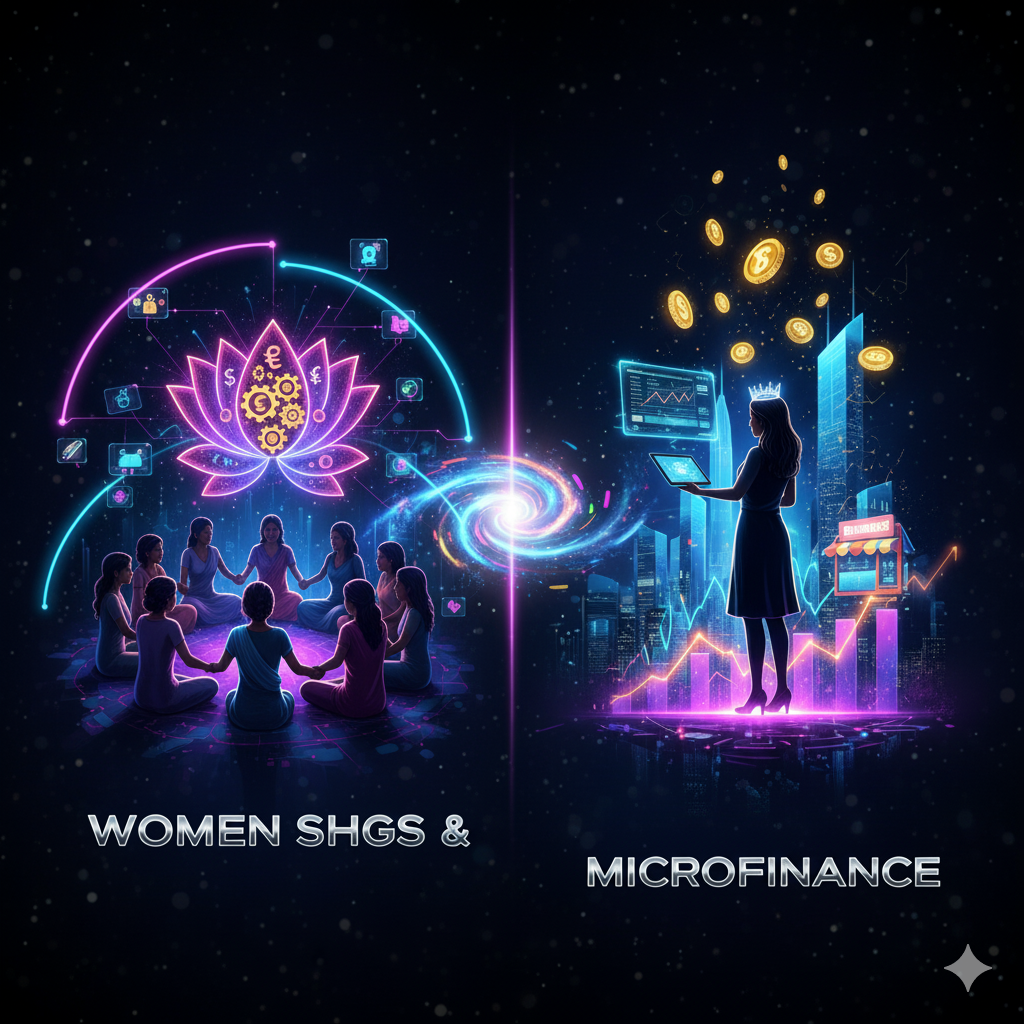
Self-Help Groups (SHGs) have emerged as a key institutional mechanism for delivering microfinance in India. An SHG is typically a small, homogeneous group of 10–20 individuals, usually women, who come together voluntarily for mutual support, savings, and credit activities. The concept gained traction in India in the 1980s and 1990s, largely due to the efforts of non-governmental organizations (NGOs) and the National Bank for Agriculture and Rural Development (NABARD). The SHG-Bank Linkage Programme, launched by NABARD in 1992, institutionalized the role of SHGs as intermediaries between rural households and formal financial institutions.
The structure of SHGs is simple yet effective. Members regularly save small amounts, which are pooled together to create a common fund. This fund forms the basis for internal lending, where members can borrow at low interest rates for consumption, business, or emergencies. As SHGs mature, they become eligible for external credit from banks, leveraging their collective savings and credit discipline. The group operates democratically, with elected leaders, regular meetings, and transparent record-keeping. This structure promotes accountability, peer monitoring, and social cohesion, which are essential for the success of microfinance initiatives.
Role of SHGs in Asset Creation
One of the primary ways SHGs contribute to poverty alleviation is through asset creation. Microloans provided through SHGs enable rural households to invest in income-generating activities such as agriculture, livestock rearing, handicrafts, tailoring, and small-scale trade. For instance, a woman may take a small loan to purchase a cow, which provides milk for both consumption and sale. Similarly, SHG loans can support small business ventures, purchase of agricultural tools, or the establishment of home-based enterprises.
The cumulative effect of these activities is the gradual accumulation of productive assets that enhance the household’s economic resilience. Asset creation is particularly significant for rural women, who often have limited access to land or formal employment. By controlling microloans and investing in assets, women can improve their household’s economic standing while also gaining bargaining power within the family. Moreover, productive assets often generate recurring income, creating a sustainable pathway out of poverty rather than temporary relief.
Studies indicate that households engaged in SHG-based microfinance programs show a higher level of asset ownership compared to non-participants. These assets not only improve income but also serve as collateral for future investments, reinforcing the cycle of economic empowerment. Thus, SHGs act as a catalyst for turning financial inclusion into tangible material assets for the rural poor.
Role of SHGs in Income Security
Income insecurity is a defining characteristic of rural poverty in India, as households often rely on seasonal agriculture, casual labor, or small-scale informal enterprises. SHGs provide a mechanism to enhance income security by offering access to low-cost credit and promoting income-generating activities. By pooling savings and providing loans, SHGs allow members to smooth consumption, cope with emergencies, and invest in productive ventures that yield steady income.
Microfinance through SHGs also introduces a culture of financial discipline and savings habit among members. Regular savings contribute to a buffer fund that can be used for emergencies such as illness, crop failure, or sudden expenditure, reducing dependency on high-interest moneylenders. Additionally, SHG-linked microfinance encourages diversification of income sources. For example, women may engage simultaneously in farming, handicrafts, and small trade, thereby reducing vulnerability to shocks.
Research suggests that participation in SHGs leads to increased household income, improved food security, and enhanced economic resilience. Income security, in turn, allows families to invest in education, healthcare, and nutrition, contributing to long-term human development. Therefore, SHGs play a dual role in poverty alleviation: they provide immediate financial relief and create conditions for sustainable income growth.
Women Empowerment through SHGs
Empowering women is an explicit and critical goal of SHG-based microfinance. In rural India, women often face social and economic marginalization, limited decision-making power, and restricted access to resources. SHGs provide a platform for women to overcome these barriers by promoting financial independence, collective action, and leadership skills.
- Financial Empowerment: By controlling savings and credit, women gain economic autonomy. Access to microloans allows them to engage in income-generating activities and contribute to household income, challenging traditional gender norms. Financial empowerment enhances women’s bargaining power within the family and reduces dependency on male members.
- Social Empowerment: SHGs foster social cohesion, collective responsibility, and community participation. Women interact regularly, share experiences, and support each other in overcoming social challenges. This social networking increases confidence, mobility, and visibility in the community, enabling women to participate in local governance and decision-making processes.
- Decision-Making Power: SHG membership improves women’s role in household decisions, including spending, education, and healthcare. Studies show that households where women control financial resources exhibit better outcomes in child nutrition, education, and health. By influencing family and community decisions, women gradually shift traditional power dynamics in rural societies.
- Capacity Building: SHGs often provide training in financial literacy, entrepreneurship, leadership, and legal rights. These skills equip women to manage businesses, access markets, and navigate bureaucratic processes. Capacity-building initiatives enhance confidence and self-reliance, ensuring that women can sustain economic and social gains over time.
In sum, SHGs serve as instruments of holistic empowerment, transforming women from passive recipients of aid to active agents of change in rural development.
Challenges and Limitations of SHGs
Despite their successes, SHGs and microfinance programs face several challenges that can limit their effectiveness in achieving the twin objectives of asset creation and income security.
- Credit Over-Indebtedness: Multiple loans from different SHGs or informal lenders can lead to over-indebtedness, undermining the financial stability of households. Poor financial planning or pressure to repay can push borrowers into stress, counteracting the intended benefits of microfinance.
- Limited Scale of Income: While microloans promote small-scale entrepreneurship, the income generated is often modest and may not be sufficient to lift households out of extreme poverty. Scaling up productive ventures requires access to larger credit, markets, and technology, which SHGs may not always provide.
- Exclusion of the Poorest: SHG-based microfinance tends to reach the “poorest of the poor” less effectively, as the most marginalized households may lack literacy, social networks, or initial capital to participate. This limits the inclusiveness of microfinance interventions.
- Market and Risk Vulnerabilities: Income-generating activities supported by microfinance are subject to market fluctuations, crop failure, and economic shocks. Without complementary insurance and risk-mitigation mechanisms, SHG members remain vulnerable.
- Quality of Capacity Building: Training programs and financial literacy initiatives vary in quality and reach. Inadequate capacity-building can limit the effectiveness of SHGs in managing funds, planning enterprises, and sustaining income growth.
Recognizing these challenges is crucial for designing policies that strengthen SHGs, improve financial literacy, and integrate complementary support systems, such as skill development, market access, and insurance services.
Policy Support and Institutional Framework
The Government of India, NABARD, and various NGOs have played a pivotal role in promoting SHGs and microfinance. Key initiatives include the SHG-Bank Linkage Programme, the National Rural Livelihood Mission (NRLM), and various state-level schemes. NRLM, launched in 2011, aims to mobilize poor rural households into SHGs and federations, providing them with access to credit, skill training, and market linkages.
Banks are encouraged to lend to SHGs based on group savings and collective credit history rather than individual collateral. This “joint liability” model reduces default risk and enhances accountability. Additionally, NGOs play a crucial role in promoting social mobilization, training, and conflict resolution within SHGs, ensuring that microfinance interventions achieve both economic and social objectives.
Internationally, India’s SHG model is recognized as a best practice in microfinance and women empowerment. It demonstrates how financial inclusion, coupled with social mobilization, can create a sustainable pathway out of poverty while addressing gender inequalities.
Case Studies and Empirical Evidence
Numerous studies and field surveys provide empirical evidence of the effectiveness of SHGs in India:
- Andhra Pradesh and Tamil Nadu: Early microfinance interventions in these states showed that SHG members experienced higher household income, increased savings, and improved asset ownership compared to non-members. Women reported enhanced decision-making power and participation in community affairs.
- Madhya Pradesh and Rajasthan: SHGs contributed to diversification of income sources, particularly in agriculture and handicrafts. Members used microloans to purchase livestock, improve irrigation, and establish small businesses, leading to better food security and income stability.
- Kerala’s Kudumbashree Model: A state-led initiative, Kudumbashree, integrates SHGs into a wider network of federations, skill training, and enterprise development. It has successfully combined poverty alleviation with women empowerment, demonstrating the scalability and sustainability of SHG-based interventions.
These examples highlight that SHGs not only facilitate microfinance but also create a platform for social change, fostering entrepreneurship, resilience, and women’s leadership.
Conclusion
Microfinance, delivered through Self-Help Groups, has proven to be an effective “anti-poverty vaccine” in rural India. By focusing on asset creation and income security, SHGs provide the rural poor with tools to overcome financial exclusion, build productive resources, and achieve sustainable livelihoods. Moreover, by targeting women, SHGs empower them economically, socially, and politically, contributing to gender equity and social transformation.
While challenges such as over-indebtedness, market vulnerabilities, and exclusion of the poorest persist, policy interventions, institutional support, and capacity-building programs have strengthened the SHG framework. The integration of financial services with skill development, market linkages, and social empowerment can further enhance the effectiveness of microfinance.
In essence, SHGs exemplify a holistic approach to poverty alleviation in India — one that combines economic empowerment with social transformation. They demonstrate that when the poor are given access to financial resources, training, and collective support, they can emerge as active participants in their own development, creating a resilient and inclusive rural economy.
References (Indicative for Educational Use)
Kudumbashree Mission, Kerala. (2020). Annual Report on Women Empowerment and SHG Activities.
NABARD. (2023). SHG-Bank Linkage Programme: Annual Report. National Bank for Agriculture and Rural Development, Mumbai.
Mahajan, V., & Sinha, P. (2022). Microfinance and Women Empowerment in India. Economic and Political Weekly, 57(15), 45-54.
Government of India. (2011). National Rural Livelihood Mission: Operational Guidelines. Ministry of Rural Development, New Delhi.
Swain, R. B., & Wallentin, F. Y. (2012). Does microfinance empower women? Evidence from self-help groups in India. International Review of Applied Economics, 26(4), 465–493.