Introduction
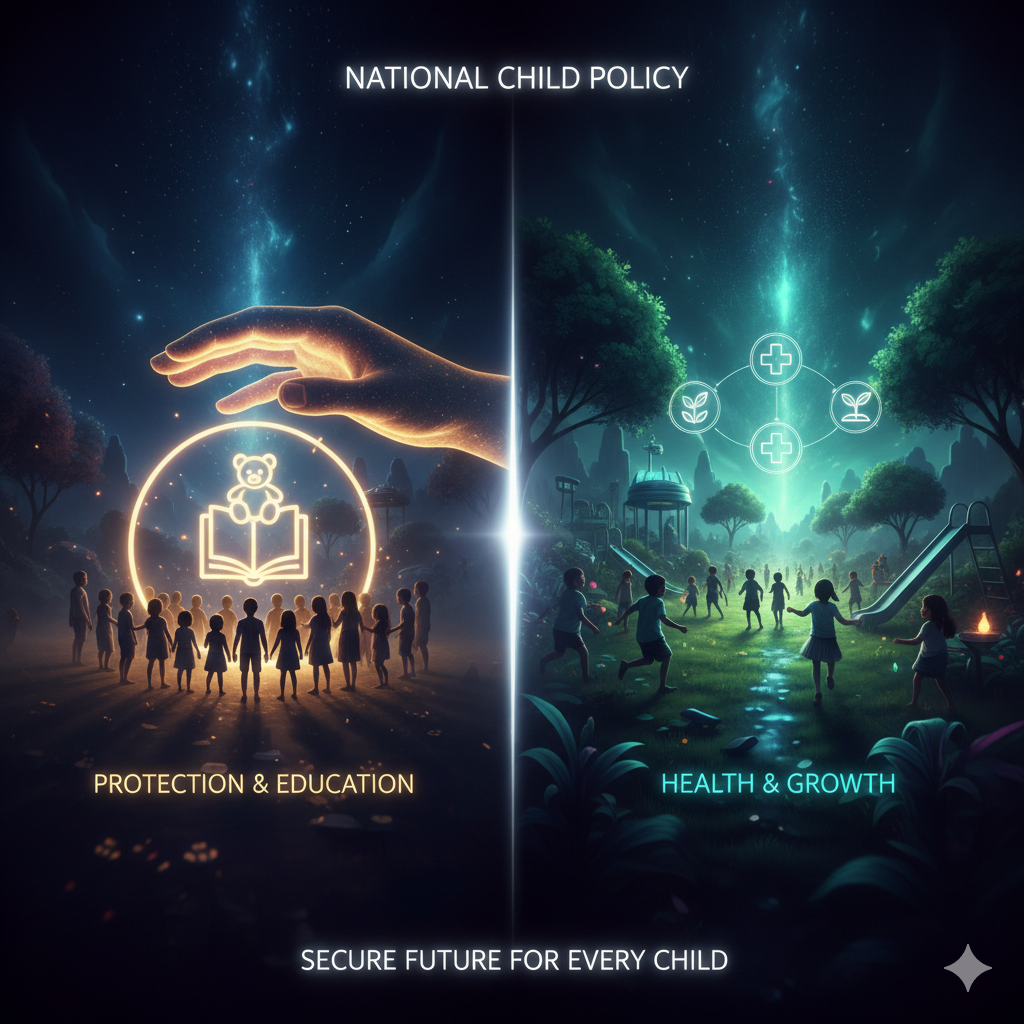
Children form the foundation of a nation’s future, and their protection, development, and well-being are central to inclusive growth and human development. Recognising this, India has developed a comprehensive National Policy for Children, first introduced in 1974, revised in 2013, and supplemented by several welfare programs and legislation in the subsequent decades.
The National Policy for Children, 2013 (NPC 2013) aims to create an environment where children are healthy, educated, protected, and nurtured, and their rights are safeguarded in line with international commitments such as the UN Convention on the Rights of the Child (CRC).
This essay examines the main provisions of the National Child Policy, evaluates the status of its implementation, identifies challenges, and suggests ways to strengthen child welfare in India.
Part I: Objectives and Principles of the National Child Policy
The National Child Policy, 2013, is guided by the following objectives:
- Survival, Health, and Nutrition: Ensuring children’s physical well-being through adequate nutrition, health care, and preventive measures.
- Education and Development: Providing universal access to quality education, early childhood care, and opportunities for holistic development.
- Protection from Exploitation and Abuse: Safeguarding children from child labor, trafficking, abuse, neglect, and violence.
- Participation and Empowerment: Encouraging children’s participation in decision-making processes in matters affecting their lives.
- Equity and Inclusion: Special focus on girls, children with disabilities, marginalized communities, and those in conflict zones.
The policy aligns with the UNCRC principles, emphasizing that children’s rights are non-negotiable, universal, and inalienable.
Part II: Main Provisions of the National Child Policy
The NPC 2013 is a comprehensive framework covering all aspects of child development, from prenatal care to adolescence. Its main provisions can be categorised as follows:
1. Health and Nutrition
- Ensuring comprehensive health care through Primary Health Centres (PHCs), Health and Wellness Centres, and immunization programs.
- Promoting maternal and child nutrition, focusing on children under six years.
- Targeting malnutrition through initiatives like Poshan Abhiyaan (National Nutrition Mission) and the Integrated Child Development Services (ICDS).
- Emphasizing mental health care and addressing substance abuse among adolescents.
2. Education and Early Childhood Development
- Universal access to quality education, consistent with the Right to Education (RTE) Act, 2009.
- Expansion of pre-school and early childhood education, focusing on holistic growth.
- Promotion of inclusive and equitable learning for children with disabilities and marginalized groups.
- Emphasis on skill-building and creativity in schools.
3. Protection from Exploitation and Abuse
- Elimination of child labor as per the Child Labour (Prohibition and Regulation) Amendment Act, 2016.
- Protection from trafficking, sexual abuse, and online exploitation.
- Strengthening the Juvenile Justice (Care and Protection of Children) Act, 2015, for rehabilitation of vulnerable children.
- Establishment of child protection committees, helplines, and grievance redress mechanisms.
4. Participation and Empowerment
- Recognising the voice of the child in matters affecting them.
- Encouraging participation in school councils, local governance forums, and child parliaments.
- Promoting awareness of child rights and responsibilities.
5. Equity and Inclusion
- Special provisions for girls, Scheduled Castes (SCs), Scheduled Tribes (STs), children with disabilities, and migrant children.
- Ensuring gender-sensitive policies, safe spaces, and equal opportunities.
- Focus on children in conflict zones, disaster-prone areas, and urban slums.
6. Adolescents and Youth
- Addressing reproductive and sexual health, mental health, and nutrition of adolescents.
- Providing life skills, career counseling, and vocational guidance.
- Prevention of risky behaviors, substance abuse, and early marriage.
7. Monitoring and Accountability
- Periodic assessment of child development indices.
- Use of data-driven planning and implementation.
- Integration with state-level child development plans.
Part III: Government Programs Supporting NPC Implementation
The NPC is implemented through various schemes and programs, covering health, education, nutrition, and protection:
1. Integrated Child Development Services (ICDS)
- Focus on health, nutrition, immunization, and early childhood education.
- Operational through Anganwadi centers, providing supplementary nutrition and pre-school education.
2. Mid-Day Meal Scheme
- Ensures nutritious meals in schools to improve attendance, retention, and health.
- Directly supports nutrition, education, and social equity.
3. National Health Mission (NHM)
- Covers maternal and child health, immunization, and adolescent health.
- Strengthens primary health infrastructure for children.
4. Right to Education (RTE) Act, 2009
- Guarantees free and compulsory education for 6–14-year-old children.
- Supports inclusive education and infrastructure development.
5. Juvenile Justice (Care and Protection of Children) Act, 2015
- Provides legal framework for protection, rehabilitation, and adoption of vulnerable children.
6. Child Labour (Prohibition and Regulation) Amendment Act, 2016
- Bans employment of children below 14 years, with exceptions for family-based work.
- Enforces rehabilitation and education of rescued children.
7. Beti Bachao Beti Padhao (BBBP)
- Promotes gender equity, girl child education, and protection.
8. National Nutrition Mission (Poshan Abhiyaan)
- Aims to reduce stunting, undernutrition, and anemia among children and adolescent girls.
9. Digital Initiatives
- Online tracking of child health and education indicators.
- Use of digital platforms for grievance redressal and awareness campaigns.
Part IV: Status of Implementation
1. Achievements
- Improved literacy rates: Literacy among children aged 6–14 has significantly improved.
- Reduction in child mortality: Infant mortality and under-5 mortality rates have declined due to vaccination and maternal care.
- Increased school enrollment: Near-universal enrollment in primary education, with decreasing gender gaps.
- Nutrition awareness and interventions: Mid-day meals and ICDS have improved child nutrition in several states.
- Legal protection mechanisms: Strengthened child protection committees, helplines, and laws against child labor and trafficking.
2. Challenges in Implementation
Despite these achievements, significant gaps remain:
- Quality of Education
- High dropout rates in upper primary classes.
- Poor learning outcomes in literacy and numeracy.
- Insufficient trained teachers and outdated pedagogy.
- Health and Nutrition Deficits
- Malnutrition persists, particularly in rural and tribal areas.
- Inadequate primary health infrastructure in remote regions.
- Low coverage of preventive care and adolescent health programs.
- Protection Challenges
- Child labor, trafficking, and abuse remain widespread in informal sectors.
- Weak enforcement of laws due to administrative constraints.
- Inadequate rehabilitation facilities for rescued children.
- Gender and Regional Disparities
- Girl children, children from SC/ST communities, and urban slum populations remain disadvantaged.
- Disparities between states in education, nutrition, and child health indices.
- Girl children, children from SC/ST communities, and urban slum populations remain disadvantaged.
- Monitoring and Coordination Gaps
- Fragmented programs across ministries limit synergy.
- Weak data collection and lack of real-time monitoring affect timely interventions.
Part V: Recommendations to Strengthen Implementation
- Enhancing Quality of Education
- Focus on learning outcomes, teacher training, and child-centered pedagogy.
- Integrate digital learning tools and activity-based education.
- Strengthening Health and Nutrition Programs
- Expand ICDS and health coverage in underserved areas.
- Improve community participation and monitoring for nutrition interventions.
- Focus on adolescent health education and mental health care.
- Protection and Legal Enforcement
- Strengthen child protection units, helplines, and rehabilitation centers.
- Ensure strict enforcement of anti-child labor and anti-trafficking laws.
- Promote awareness campaigns for parents and communities.
- Gender and Inclusion Measures
- Enhance girl child education, health, and skill development programs.
- Target marginalized communities through scholarships and special programs.
- Inter-sectoral Convergence and Monitoring
- Ensure coordinated implementation of education, health, and protection programs.
- Use data-driven policy interventions, real-time monitoring, and accountability frameworks.
- Community Participation and Awareness
- Engage parents, local bodies, NGOs, and civil society in child welfare initiatives.
- Promote child rights awareness among communities and schools.
- Innovation and Technology Use
- Expand digital tracking of child health, nutrition, and education indicators.
- Use e-learning, telemedicine, and mobile apps to reach remote populations.
Conclusion
The National Child Policy, 2013, provides a comprehensive framework for the holistic development, protection, and empowerment of children in India. Its provisions cover health, nutrition, education, protection, participation, and equity, aligning with international commitments and the UNCRC.
Significant progress has been made in literacy, school enrollment, child health, and protection mechanisms, reflecting the government’s commitment. However, quality gaps, regional disparities, protection challenges, and monitoring deficits continue to limit the policy’s full impact.
To achieve the policy’s objectives and ensure that every child thrives, learns, and is protected, India must focus on quality improvement, inclusion, community engagement, legal enforcement, inter-sectoral convergence, and technology integration. Strengthened implementation of the National Child Policy will not only safeguard the rights of children but also build a healthy, educated, and empowered future workforce, contributing to sustainable national development.