Introduction
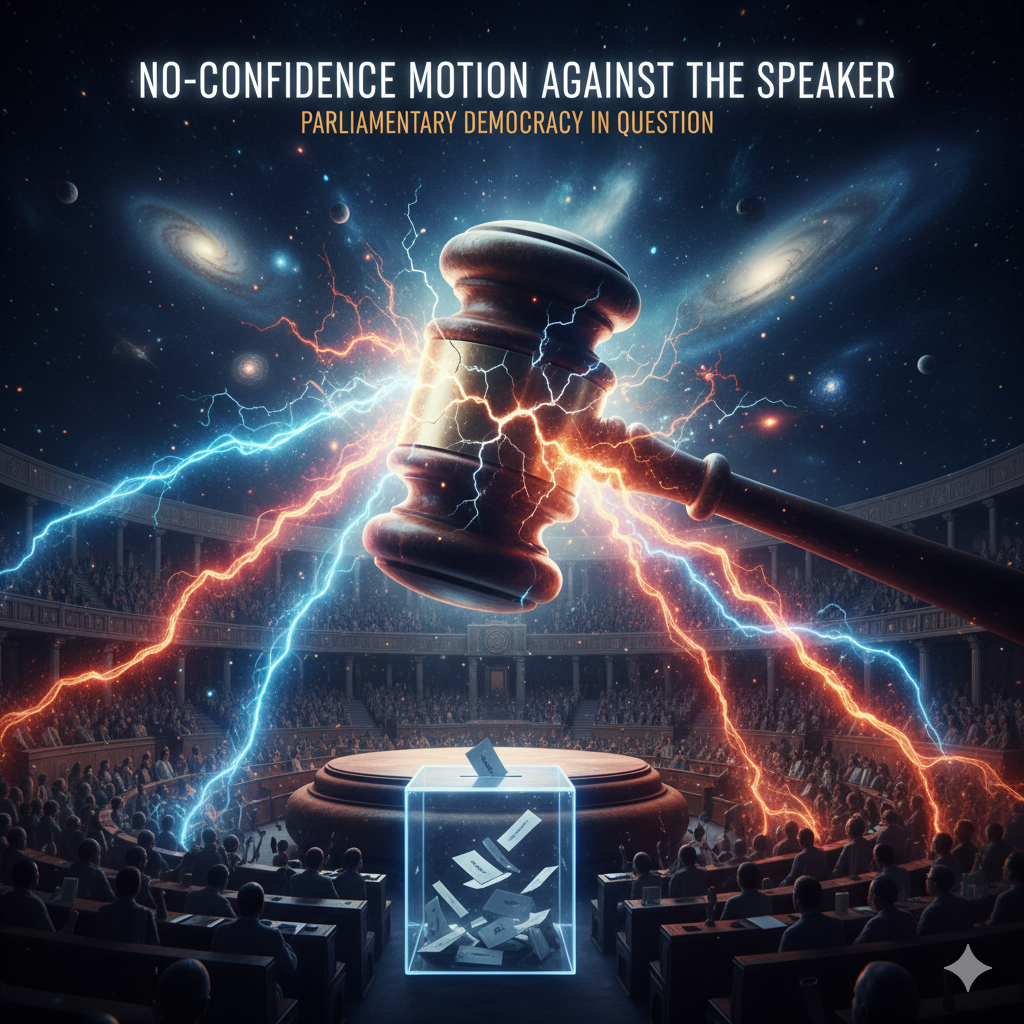
In a parliamentary democracy, the Speaker occupies a uniquely powerful yet impartial position. The Speaker is expected to rise above party politics and act as the guardian of legislative propriety. However, when members of the House believe that this neutrality has been compromised, they may attempt to challenge the Speaker’s authority through a formal motion. One such mechanism is the No-Confidence Motion against the Speaker.
In India, this issue carries special constitutional importance because the Speaker presides over debates, certifies money bills, decides disqualification matters under anti-defection law, and represents the dignity of the legislature. Any loss of confidence in this office therefore has serious institutional consequences.
This article explains the constitutional basis, procedural aspects, political implications, and democratic relevance of a no-confidence motion against the Speaker, while also examining its challenges and future reforms.
Understanding the Office of the Speaker
The Speaker is the presiding officer of the House, whether in Lok Sabha or in a State Legislative Assembly. After being elected by members of the House, the Speaker is expected to detach from active party politics and function as a neutral authority.
Core Responsibilities of the Speaker
The Speaker’s role extends far beyond conducting proceedings:
- Maintaining order and discipline during debates
- Interpreting rules of procedure
- Deciding who gets to speak and for how long
- Certifying money bills
- Referring bills to committees
- Deciding petitions under the anti-defection law
- Acting as the administrative head of the legislature
Because of these powers, the Speaker becomes central to both governance and opposition politics.
What Does “No-Confidence Against the Speaker” Mean?
A no-confidence motion against the Speaker is a formal expression by members of the House stating that they no longer trust the Speaker to perform duties impartially.
Unlike a no-confidence motion against the government, which seeks to remove the executive, this motion targets the presiding officer of the legislature.
In practical terms, such a motion is equivalent to seeking the Speaker’s removal from office.
Constitutional Basis
The Indian Constitution provides mechanisms for removing a Speaker:
Article 94 (for Lok Sabha)
The Speaker may vacate office if:
- They resign voluntarily
- They cease to be a member of the House
- They are removed by a resolution passed by a majority of all current members of the House, with at least 14 days’ notice
Similar provisions exist for State Assemblies.
Thus, while the term “no-confidence” is commonly used in political discourse, constitutionally it operates through a removal resolution.

Procedure for Moving a Motion Against the Speaker
The process generally follows these steps:
1. Notice Period
Members must submit a formal notice (usually at least 14 days in advance).
2. Admission of Motion
The House examines whether the motion satisfies procedural requirements.
3. Debate
If admitted, members debate the conduct and neutrality of the Speaker.
4. Voting
A majority of the total membership of the House is required for removal.
Until the motion is disposed of, the Speaker usually does not preside over the House.
Why Do Such Motions Arise?
Several factors may lead legislators to initiate such action:
Allegations of Bias
Opposition parties often accuse Speakers of favoring the ruling party in allowing debates, suspending members, or scheduling business.
Anti-Defection Decisions
Since Speakers decide disqualification petitions, delays or selective rulings frequently spark controversy.
Procedural Manipulation
Claims that rules are being selectively interpreted can erode trust.
Political Strategy
Sometimes, such motions are also tactical tools to apply pressure or draw public attention to perceived institutional erosion.
Democratic Significance
The Speaker’s neutrality is foundational to parliamentary democracy. When that neutrality is questioned, the very credibility of legislative institutions is at stake.
A no-confidence motion against the Speaker reflects deeper issues:
- Breakdown of trust between ruling party and opposition
- Perceived weakening of institutional independence
- Increasing politicisation of constitutional offices
While the motion itself is a democratic instrument, its frequent use indicates systemic stress.

Difference Between No-Confidence Against Government and Speaker
| Aspect | Government | Speaker |
|---|---|---|
| Target | Executive | Presiding Officer |
| Objective | Change government | Remove Speaker |
| Majority Required | Simple majority | Majority of total membership |
| Political Impact | Direct regime change | Institutional rebalancing |
This shows that action against the Speaker is constitutionally more demanding and symbolically more serious.
Judicial Perspective
Indian courts have repeatedly emphasized the importance of Speaker neutrality, especially in matters related to defections and legislative procedure.
Although courts usually avoid interfering in internal parliamentary matters, they step in when constitutional values such as fairness and natural justice appear violated.
Judicial scrutiny has therefore become an indirect accountability mechanism for Speakers.
Comparative Insight
In many parliamentary democracies, Speakers resign from party membership upon election to preserve neutrality.
India follows a different convention: Speakers technically retain party affiliation, though expected to act impartially. This structural feature often fuels allegations of bias and increases the likelihood of confrontations.
Challenges in the Current Framework
Political Polarisation
Deep partisan divides make neutrality harder to maintain and easier to question.
Delay in Defection Cases
Pending disqualification petitions undermine legislative stability.
Lack of Clear Timelines
The Constitution does not prescribe deadlines for Speaker decisions, creating scope for strategic delays.
Weak Accountability
Apart from removal motions or judicial review, there are limited mechanisms to check Speaker conduct.
Suggested Reforms
To strengthen the institution:
Fixed Timelines
Mandating time limits for deciding defection cases.
Independent Tribunal
Shifting anti-defection decisions from Speaker to an independent authority.
Codified Neutrality Norms
Clear ethical standards for Speakers.
Stronger Parliamentary Committees
Greater role for committees in procedural disputes.
Such reforms could restore trust and reduce confrontational politics.
Relevance for UPSC / UPPCS
This topic directly links with:
- GS-II (Polity & Governance)
- Parliamentary procedures
- Role of constitutional authorities
- Anti-defection law
- Institutional ethics
It is highly suitable for mains answers, essays, and current affairs analysis.
Conclusion
A no-confidence motion against the Speaker is not merely a procedural event; it reflects the health of democratic institutions. While the Constitution provides safeguards to ensure stability, recurring disputes over Speaker impartiality signal deeper governance challenges.
For Indian democracy to mature further, the Speaker must be insulated from partisan pressures, and accountability mechanisms must evolve alongside political realities. Only then can legislatures function as genuine arenas of debate rather than battlegrounds of procedural warfare.
Ultimately, preserving the dignity and neutrality of the Speaker is essential for maintaining public faith in parliamentary democracy.