Introduction
Water, Sanitation, and Hygiene (WASH) form the foundation of public health, human dignity, and sustainable development. In a country like India, where population pressure, socio-economic inequality, and environmental stress intersect, WASH interventions are not merely infrastructure projects but instruments of social transformation. Over the years, India has launched several ambitious WASH-related initiatives, including sanitation drives, drinking water missions, and hygiene awareness programs.
However, despite significant investments and visible progress, gaps persist between policy intent and actual outcomes. One of the key reasons for this gap lies in improper or misaligned identification of beneficiaries, which often fails to correspond with the anticipated outcomes of WASH policies. The statement that “to ensure effective implementation of policies addressing water, sanitation and hygiene needs, the identification of the beneficiary is to be synchronized with the anticipated outcomes” highlights a critical governance challenge.
This essay examines the relevance of this statement in the context of WASH schemes in India, analyzing why beneficiary identification matters, how misalignment affects outcomes, and what reforms are needed to ensure meaningful and sustainable WASH delivery.
Understanding WASH and Its Developmental Significance
WASH refers to integrated interventions in three closely linked areas:
- Water: Access to safe, adequate, and reliable drinking water
- Sanitation: Safe disposal of human waste and solid/liquid waste management
- Hygiene: Practices such as handwashing, menstrual hygiene, and food sanitation
These components are interdependent. Improvements in one area without progress in others often yield limited results. For example, toilet construction without behavior change or water availability does not eliminate open defecation or disease transmission.
WASH is directly linked to:
- Reduction in water-borne and sanitation-related diseases
- Improved child nutrition and cognitive development
- Women’s safety, dignity, and time use
- Economic productivity and healthcare cost reduction
Given these multi-dimensional outcomes, beneficiary identification becomes a strategic decision, not a mere administrative step.
Beneficiary Identification: Meaning and Importance
Beneficiary identification refers to the process of determining who should receive WASH-related services, infrastructure, subsidies, or behavioral interventions. Traditionally, identification has been based on broad categories such as households below the poverty line, rural habitations, or geographic regions.
However, effective WASH outcomes require context-sensitive targeting, because vulnerabilities related to water and sanitation vary across:
- Regions (arid vs water-rich areas)
- Social groups (women, children, marginalized communities)
- Occupations (migrant workers, sanitation workers)
- Life stages (pregnant women, adolescent girls, elderly)
Synchronizing beneficiary identification with anticipated outcomes means that the right people receive the right intervention for the right purpose, ensuring that policy outputs translate into real improvements in health, dignity, and quality of life.
Anticipated Outcomes of WASH Policies
Before examining synchronization, it is important to understand the typical outcomes expected from WASH interventions:
- Health Outcomes
Reduction in diarrheal diseases, stunting, anemia, and water-borne infections. - Behavioral Outcomes
Sustained toilet use, handwashing practices, safe water storage, and hygiene awareness. - Social Outcomes
Enhanced dignity, reduced caste-based sanitation inequities, improved gender safety. - Environmental Outcomes
Reduced groundwater contamination, improved waste management, and cleaner habitats. - Economic Outcomes
Savings in healthcare expenditure, increased productivity, and reduced time poverty.
If beneficiary identification does not align with these outcomes, schemes risk becoming infrastructure-heavy but impact-light.
WASH Schemes in India: A Brief Overview
India’s WASH framework includes several flagship initiatives:
- Sanitation-focused programs aimed at eliminating open defecation
- Drinking water missions targeting household-level tap water supply
- Hygiene and behavior change campaigns promoting cleanliness and awareness
- School and Anganwadi WASH initiatives focusing on children and adolescents
These schemes have expanded coverage significantly. However, evaluation studies reveal that access does not always translate into usage, quality, or sustainability, raising questions about beneficiary targeting.
Why Synchronization Between Beneficiary Identification and Outcomes Is Crucial
Addressing Differential Vulnerabilities
Not all households face the same WASH challenges. For instance, a household may have a toilet but lack water supply, making sanitation ineffective. Similarly, urban slum dwellers may face shared sanitation issues that differ from rural open defecation concerns.
Without identifying beneficiaries based on specific vulnerabilities, anticipated outcomes such as improved health or hygiene behavior remain unrealized.
Ensuring Behavioral Change, Not Just Infrastructure
Many WASH schemes initially focused on physical targets such as toilet construction or water connections. However, the actual outcome depends on consistent usage and behavior change.
If beneficiaries are identified solely as “households without toilets” rather than “households practicing open defecation due to behavioral or cultural reasons,” interventions may fail to change habits.
Optimizing Resource Allocation
Public resources for WASH are finite. Misidentification leads to:
- Inclusion errors (benefits to those who do not need them)
- Exclusion errors (denial to the most vulnerable)
Synchronizing identification with outcomes ensures cost-effectiveness and equity, particularly in resource-scarce regions.
Challenges in Current Beneficiary Identification Processes
Over-Reliance on Quantitative Indicators
Beneficiary selection often relies on easily measurable indicators such as income level or asset ownership. These indicators may not reflect actual WASH deprivation, such as water quality, seasonal scarcity, or social exclusion.
Inadequate Local Contextualization
Centralized guidelines may not adequately capture local realities. For example, water access challenges in tribal areas differ significantly from those in peri-urban settlements.
Gender and Social Blind Spots
Women and girls bear a disproportionate burden of poor WASH conditions, especially in relation to menstrual hygiene and safety. However, beneficiary identification is often household-centric, ignoring intra-household inequalities.
Weak Data Integration
Fragmented databases across departments limit the ability to identify beneficiaries holistically. Lack of integration between health, nutrition, water, and sanitation data undermines outcome-based targeting.
Implications of Poor Synchronization
Limited Health Gains
Evidence shows that sanitation coverage alone does not automatically reduce disease unless combined with hygiene behavior and safe water. Poor targeting results in sub-optimal health outcomes, particularly for children.
Sustainability Concerns
Water infrastructure without community ownership or capacity-building often falls into disrepair. Beneficiary identification that ignores long-term sustainability undermines anticipated outcomes.
Persistence of Inequality
Marginalized communities may remain underserved despite overall improvements in coverage, reinforcing social and spatial inequalities.
Synchronization in Practice: What It Should Look Like
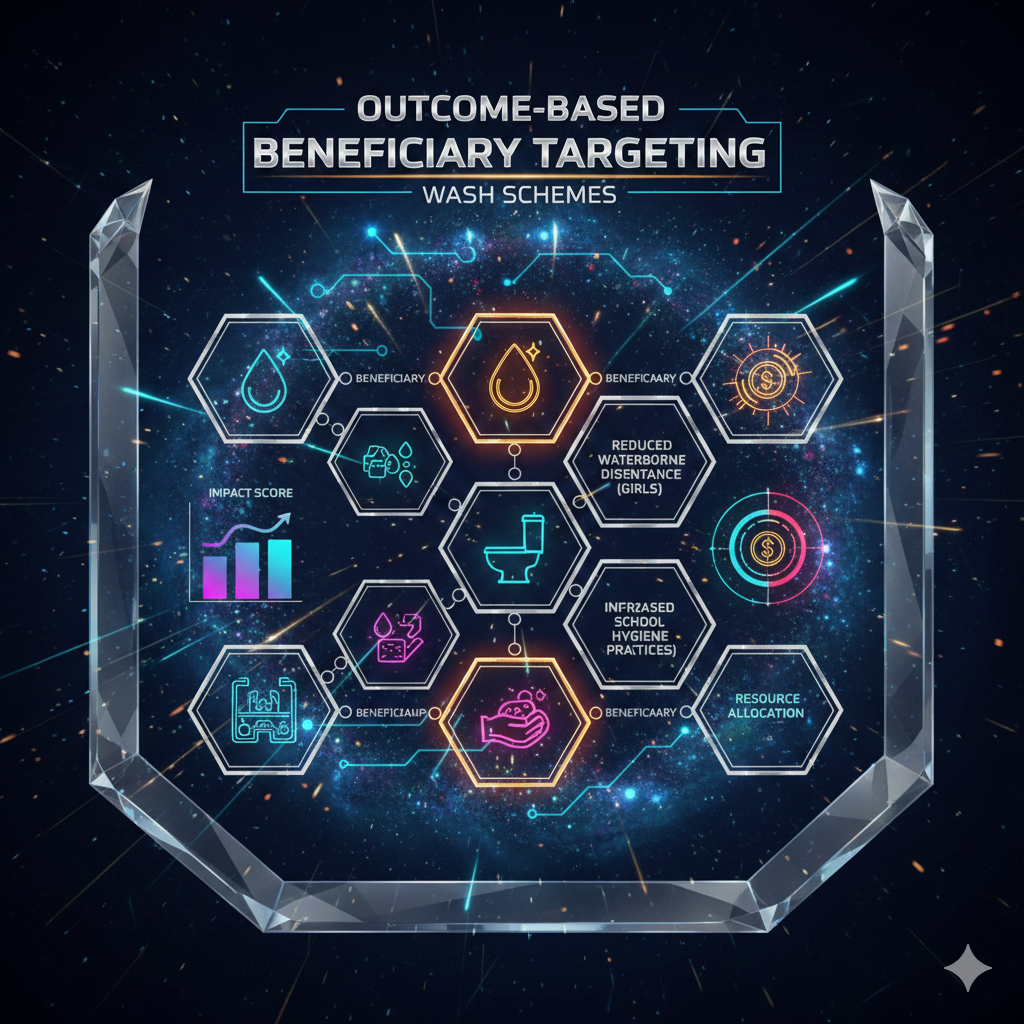
Outcome-Oriented Targeting
Beneficiary identification should begin with the question: What outcome is the policy trying to achieve? For example:
- If the goal is reducing child malnutrition, target households with young children and poor hygiene practices.
- If the goal is women’s dignity, prioritize sanitation facilities in schools, workplaces, and public spaces.
Use of Disaggregated and Real-Time Data
Disaggregated data by gender, age, caste, location, and occupation enables precise targeting. Technology-enabled monitoring can help adjust beneficiary lists dynamically.
Community Participation
Local communities are best placed to identify genuine needs. Participatory planning improves accuracy, accountability, and acceptance of WASH interventions.
Integration Across Sectors
Synchronizing beneficiary identification requires coordination between health, education, nutrition, water, and rural development sectors to achieve convergent outcomes.
Way Forward: Strengthening Synchronization Mechanisms
Shift from Target-Driven to Outcome-Driven Governance
Policy success should be measured not by the number of toilets or taps installed, but by health indicators, usage rates, and behavioral change.
Capacity Building at Local Levels
Local governments and frontline workers need training to understand outcome-based identification and monitoring.
Strengthening Social Audits and Feedback Loops
Regular social audits and beneficiary feedback can correct targeting errors and align implementation with ground realities.
Focus on Life-Cycle Approach
WASH needs vary across life stages. Tailoring beneficiary identification to children, adolescents, women, workers, and the elderly enhances policy impact.
Conclusion
The effectiveness of WASH policies depends not only on financial investment or infrastructure creation but fundamentally on how beneficiaries are identified and targeted. Synchronizing beneficiary identification with anticipated outcomes ensures that WASH interventions move beyond symbolic achievements to deliver tangible improvements in health, dignity, and quality of life.
In the Indian context, where diversity and inequality shape WASH challenges, outcome-oriented beneficiary identification is both a governance necessity and a moral imperative. By aligning who receives benefits with what the policy seeks to achieve, WASH schemes can become more inclusive, sustainable, and transformative.
Ultimately, WASH is not just about water pipes or toilets—it is about people, outcomes, and long-term human development.