Introduction
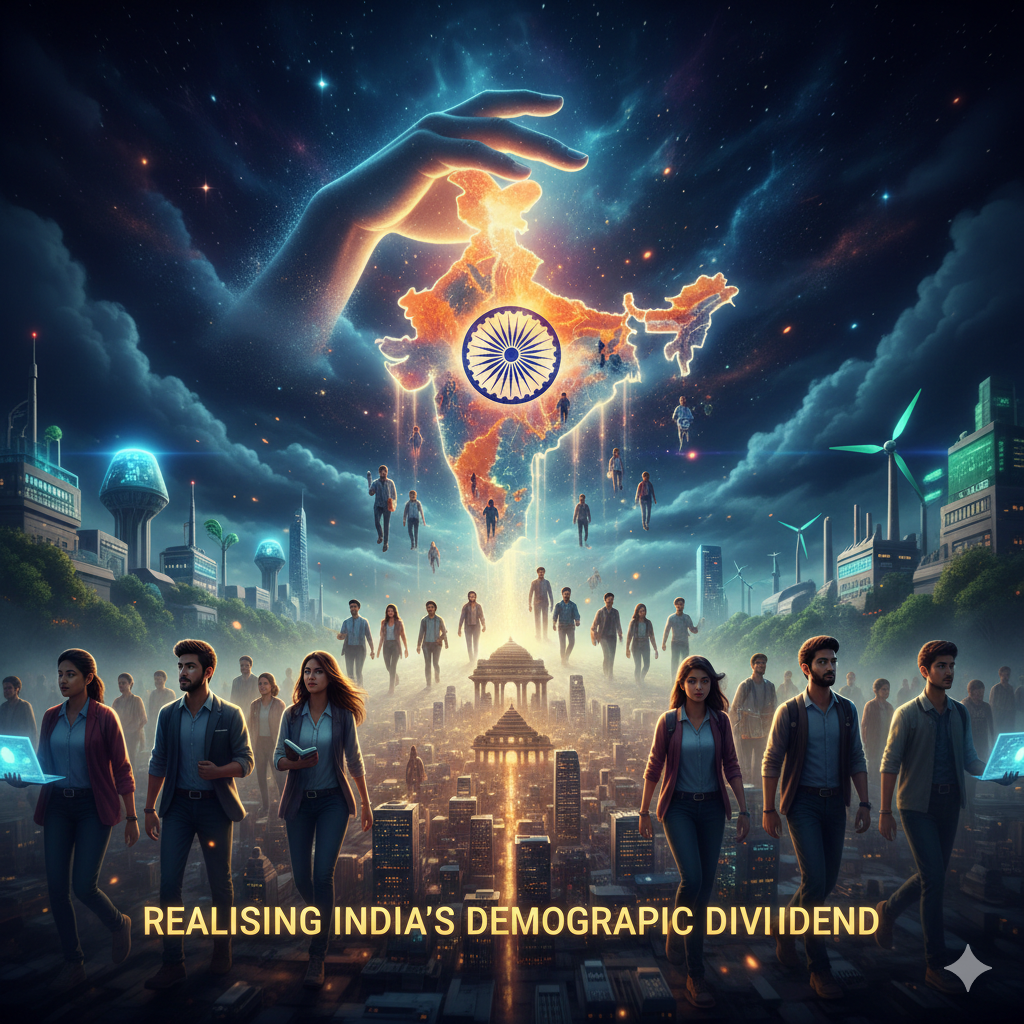
India is often described as a country poised for a demographic dividend, with a large proportion of its population in the working-age group (15–59 years). This demographic structure provides a unique opportunity to accelerate economic growth, improve global competitiveness, and enhance social development.
However, the demographic dividend remains theoretical unless India’s human capital becomes educated, skilled, aware, and creative. Simply having a large workforce is not sufficient; productivity, employability, and innovation determine whether this potential translates into tangible development outcomes.
Recognising this, the Government of India has implemented a series of policies and programmes aimed at improving education, vocational training, skill development, entrepreneurship, and digital literacy, with the objective of enhancing the capacity of the population to contribute meaningfully to the economy.
This essay examines the measures taken by the government to enhance India’s human capital and evaluates their effectiveness in realising the demographic dividend.
Part I: Understanding the Demographic Dividend
Concept of Demographic Dividend
The demographic dividend refers to the economic growth potential arising from a shift in a population’s age structure, typically when the proportion of working-age individuals exceeds dependents. For India, this dividend is expected to last until 2050, offering a window to accelerate economic growth if appropriate human capital investments are made.
Challenges to Realising the Dividend
- Low educational attainment: Many youth lack basic literacy, numeracy, and critical thinking skills.
- Skill mismatch: The workforce often lacks market-relevant vocational and technical skills.
- Limited creativity and innovation: Educational systems historically emphasise rote learning over problem-solving and innovation.
- Unemployment and underemployment: Even educated youth face barriers to formal employment.
- Gender and regional disparities: Women and certain regions remain underrepresented in productive employment.
Without addressing these challenges, India risks a demographic liability, with a large but unproductive and underemployed workforce.
Part II: Measures Taken by the Government to Enhance Human Capital
The government’s approach to leveraging the demographic dividend is multi-pronged, focusing on education, skill development, vocational training, entrepreneurship, digital literacy, and social empowerment.
1. Education Initiatives
Universalisation of Elementary Education
- Sarva Shiksha Abhiyan (SSA): Aims to provide free and compulsory education for children aged 6–14. Focuses on enrollment, retention, and quality learning outcomes.
- Right to Education (RTE) Act, 2009: Guarantees free and compulsory education for all children, emphasising inclusive and equitable access.
- Focus on infrastructure, teacher training, mid-day meals, and learning material distribution.
Secondary and Higher Education
- Rashtriya Madhyamik Shiksha Abhiyan (RMSA): Improves access, quality, and equity in secondary education.
- Expansion of higher education institutions, universities, and technical institutes to accommodate growing youth.
- Initiatives like National Institutional Ranking Framework (NIRF) promote quality improvement and global competitiveness.
Outcome
- Significant improvement in literacy rates (77.7% as of 2021 Census).
- Increased enrollment and transition from primary to secondary education.
- Challenges remain in learning outcomes, dropout rates, and quality disparities across states.
2. Skill Development Initiatives
To ensure youth are employable, the government launched targeted skill development programmes.
Skill India Mission (National Policy for Skill Development and Entrepreneurship)
- Launched in 2015 to create a large, skilled workforce aligned with industry needs.
- Focuses on training youth in vocational and technical skills across sectors such as manufacturing, IT, healthcare, and services.
Pradhan Mantri Kaushal Vikas Yojana (PMKVY)
- Provides short-term training, certification, and placement support.
- Includes sector-specific skills and recognition of prior learning for informal workers.
- Emphasises industry participation to ensure employability.
National Skill Development Corporation (NSDC)
- Public-private partnership to scale up vocational training infrastructure.
- Partners with industries to bridge skill gaps and promote entrepreneurship.
3. Higher Education Reforms for Employability
- Institutes of Eminence (IoE): Encourage select universities to achieve world-class standards.
- National Education Policy (NEP) 2020: Emphasises flexible curricula, multidisciplinary learning, skill integration, and critical thinking.
- Expansion of technical education, polytechnics, and community colleges to impart applied skills.
4. Vocational Education and Apprenticeship Programs
- Apprenticeship Act and Programs: Facilitate on-the-job training across industrial and service sectors.
- Integration of vocational courses in school and college curricula, enabling early exposure to employable skills.
- Sector Skill Councils identify industry requirements and align training programs.
5. Entrepreneurship and Self-Employment
Promoting self-employment is crucial to absorb a growing workforce.
- Startup India Initiative: Encourages youth entrepreneurship through funding, tax benefits, incubation centers, and mentorship.
- Stand-Up India Scheme: Supports women and SC/ST entrepreneurs to start small businesses.
- MUDRA Scheme: Provides microcredit to small and micro-entrepreneurs, enhancing livelihood opportunities.
6. Digital Literacy and Innovation
- Digital India Programme: Focus on ICT skills, e-governance awareness, and access to digital platforms.
- National Digital Literacy Mission: Ensures youth and marginalized communities acquire basic computer and digital skills.
- Integration of digital skills in higher education and vocational training enhances employability in modern industries.
7. Health and Nutrition Interventions
A productive workforce requires healthy citizens.
- Ayushman Bharat – Health and Wellness Centres: Focus on preventive and primary health care.
- Mid-Day Meal Scheme: Improves nutrition and school attendance simultaneously.
- National Nutrition Mission (Poshan Abhiyaan): Addresses malnutrition among children and women, enhancing cognitive development and future productivity.
8. Social Empowerment and Awareness Programs
- Skill and literacy programs for women improve workforce participation.
- Awareness campaigns on financial literacy, civic engagement, and sustainable practices empower youth to make informed choices.
- Youth organizations and NSS programs build leadership, responsibility, and creativity.
9. Public-Private Partnerships (PPP) in Human Capital Development
- Collaborations with industry and NGOs expand training infrastructure and mentorship.
- Initiatives like IBM, TCS, and Infosys training centers enhance technical and employable skills.
- PPP model ensures industry-relevant curriculum and better placement opportunities.
Part III: Challenges in Realising the Demographic Dividend
Despite these measures, several barriers remain:
- Quality Gaps: Expansion of education and training has not always ensured high-quality learning outcomes.
- Mismatch Between Skills and Industry Needs: Many graduates lack practical, industry-ready skills.
- Regional Disparities: Southern and urban regions benefit more from initiatives than northern and rural areas.
- Low Female Workforce Participation: Gender gaps limit the potential demographic dividend.
- Informal Employment Dominance: Many youth remain employed in low-productivity, informal jobs without social security.
- Innovation and Creativity Gaps: Education and training systems still under-emphasize critical thinking, problem-solving, and entrepreneurship.
Part IV: Recommendations to Enhance Capacity and Productivity
- Focus on Learning Outcomes, Not Just Enrollment
- Emphasize competency-based education, formative assessments, and remedial support.
- Expand Vocational Education and Apprenticeship
- Align vocational programs with emerging sectors like AI, renewable energy, biotechnology.
- Promote Lifelong Learning and Reskilling
- Continuous skill upgradation for youth and adult workforce to adapt to technological changes.
- Integrate Technology in Education and Training
- Use digital platforms, virtual labs, and simulation-based learning.
- Strengthen ICT training and e-governance skills.
- Enhance Women’s Participation in Workforce
- Targeted skill development and entrepreneurship programs for women.
- Social reforms to improve mobility, safety, and work-life balance.
- Promote Innovation and Creativity
- Encourage problem-solving projects, hackathons, and entrepreneurship incubators in schools and universities.
- Strengthen Health and Nutrition Programs
- Ensure all youth are healthy, nutritionally secure, and capable of full cognitive and physical development.
- Public-Private-Academia Collaboration
- Industry-academia linkages for curriculum design, internships, and skill certification.
- PPP models to ensure employability and entrepreneurship training.
- Regional and Social Inclusion
- Special focus on tribal, backward, and rural areas.
- Scholarships, infrastructure, and mentorship for marginalized groups.
- Monitoring and Outcome-Based Evaluation
- Track progress using learning metrics, employment outcomes, and productivity indicators.
- Use data to adjust policies and target interventions effectively.
Conclusion
India’s demographic dividend is a time-bound opportunity that can propel the nation to unprecedented economic growth and social development. However, sheer numbers of youth do not automatically translate into a demographic advantage. Education, skill development, health, awareness, creativity, and employability are essential to transform the potential workforce into productive human capital.
The Government of India has undertaken significant measures across education, vocational training, health, entrepreneurship, and digital literacy to enhance capacity and employability. While progress is visible, challenges such as quality gaps, skill mismatches, gender disparities, and regional inequalities remain.
To fully realise the demographic dividend, India must adopt a holistic, integrated, and outcome-driven approach, combining political commitment, administrative efficiency, public-private collaboration, and social empowerment. Only then will India’s large and youthful population become the engine of sustainable economic growth, innovation, and global competitiveness.