Introduction
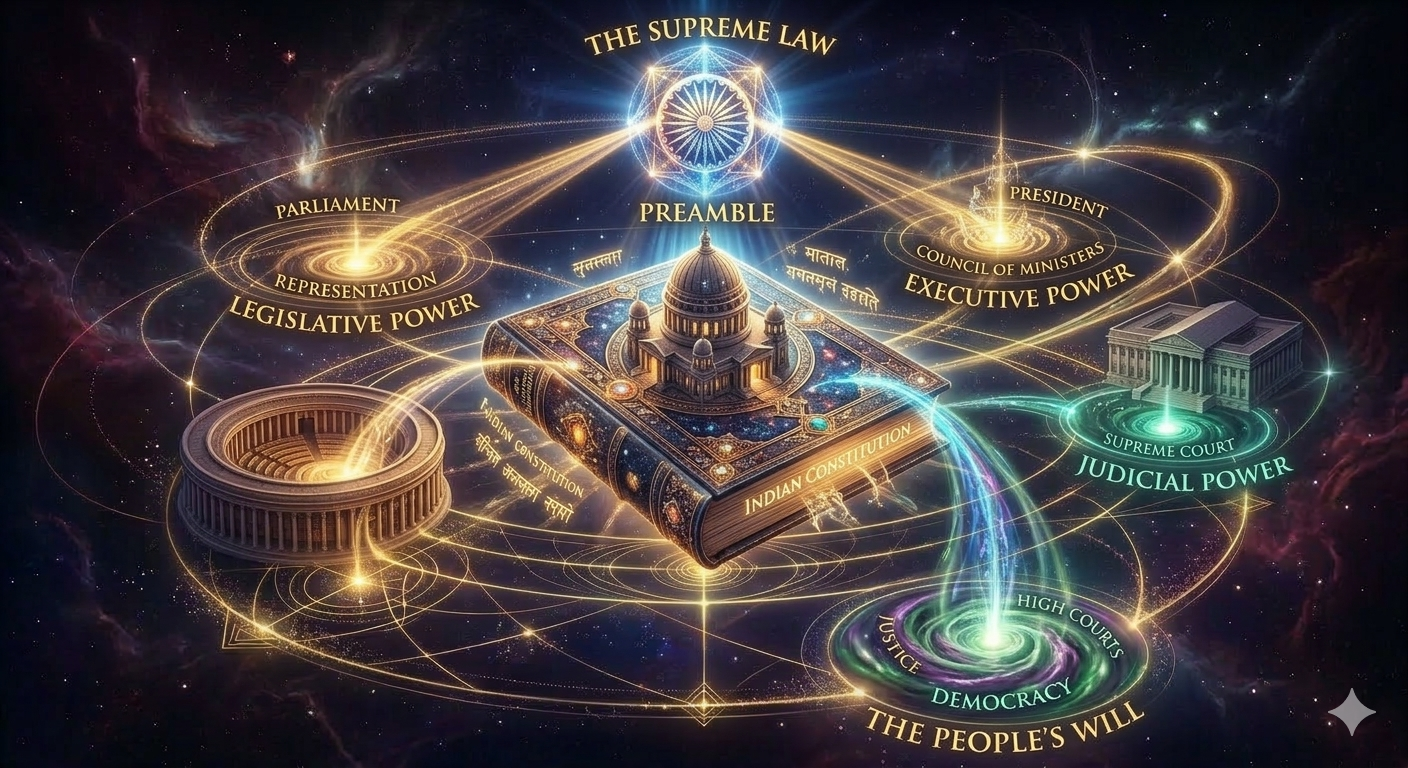
The office of the President occupies a central position in the constitutional framework of India. The President is regarded as the constitutional head of the Indian state and represents the unity, integrity, and sovereignty of the nation. The position of the President is defined and regulated by the Constitution of India, which outlines the powers, responsibilities, and limitations of this office.
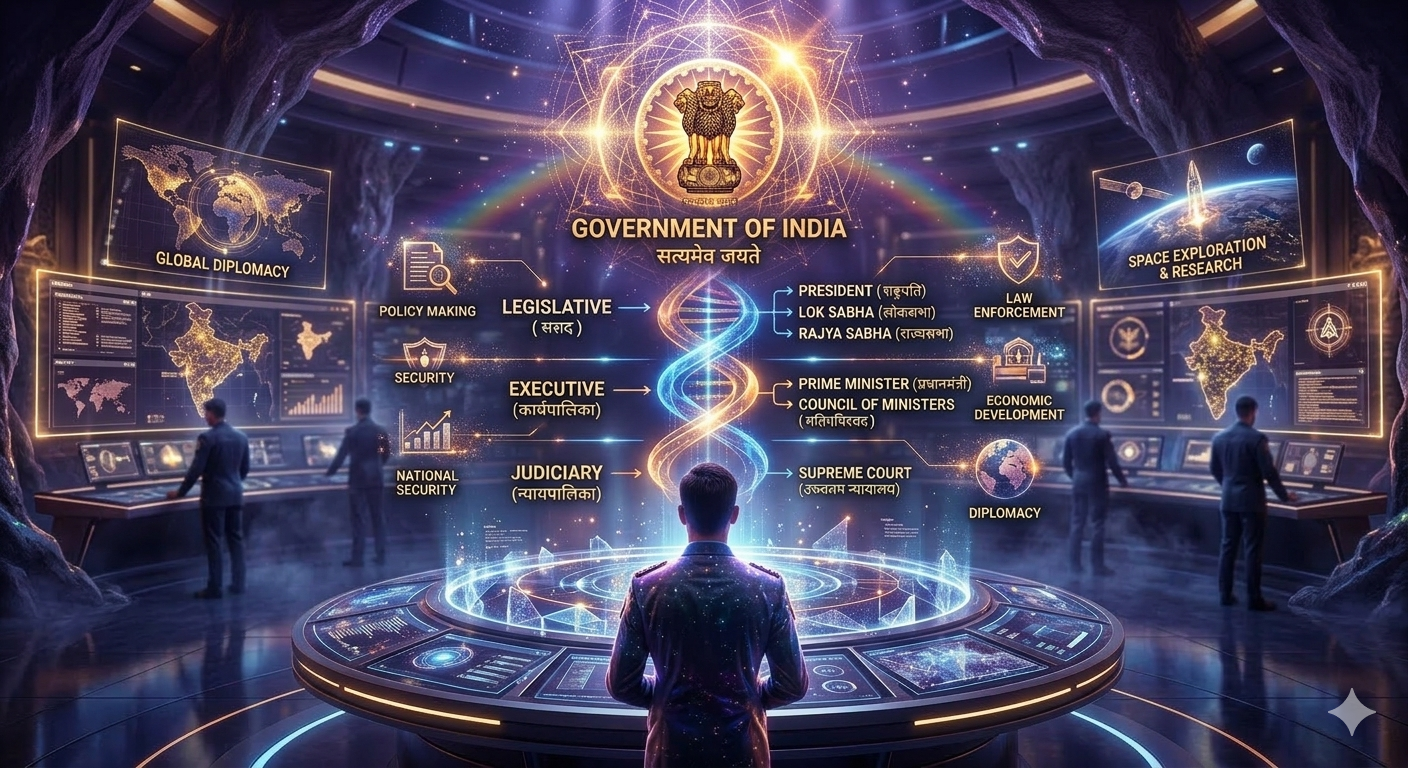
Although India follows a parliamentary system of government, where real executive authority lies with the Council of Ministers headed by the Prime Minister, the President plays an essential constitutional role in maintaining the smooth functioning of governance. The President acts as the guardian of constitutional processes and ensures that government actions remain within the legal framework.
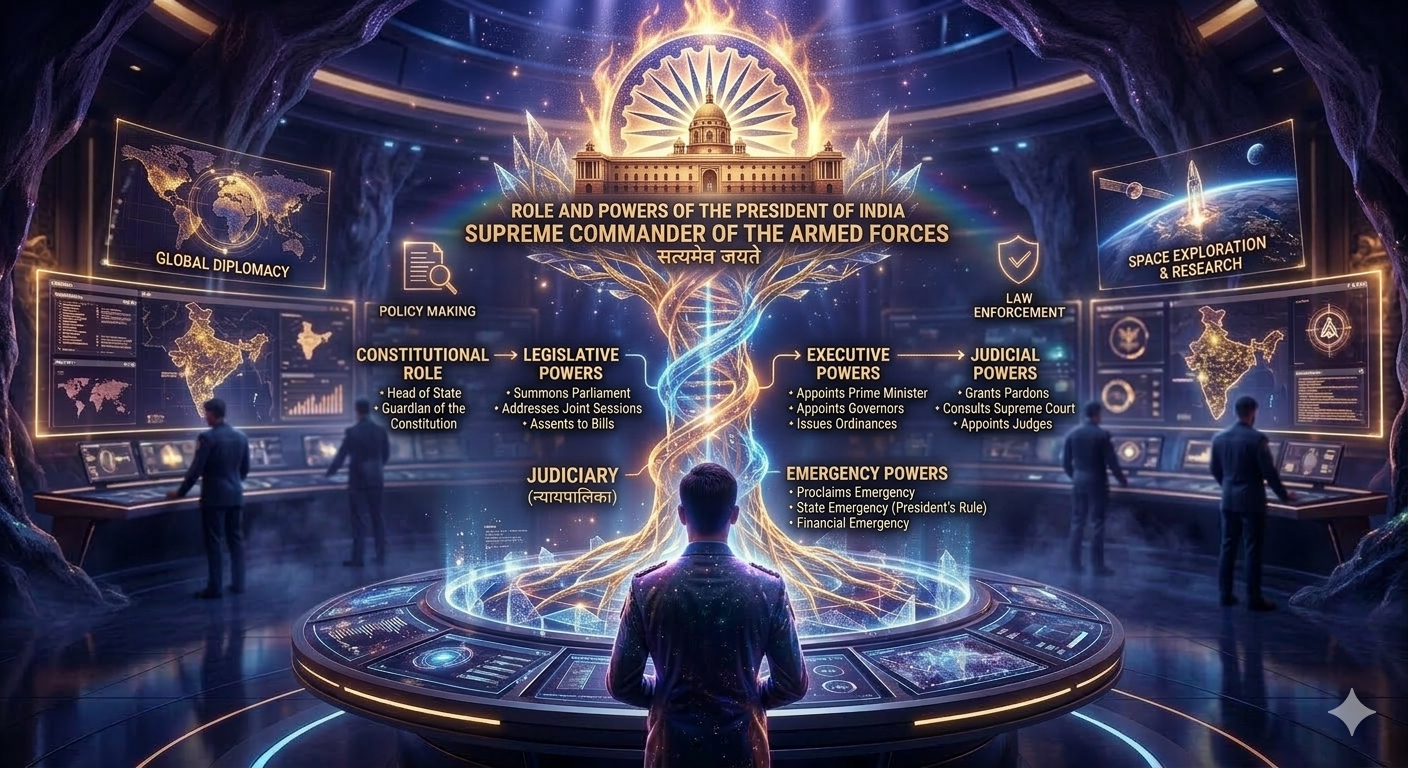
The Constitution provides the President with several powers, which can broadly be classified into executive powers, legislative powers, judicial powers, financial powers, diplomatic powers, military powers, and emergency powers. These powers enable the President to perform various constitutional functions and maintain balance within the democratic system.
Constitutional Position of the President of India
Status under the Constitution
The Constitution provides that the executive power of the Union shall be vested in the President of India. However, these powers are exercised in accordance with the advice of the Council of Ministers led by the Prime Minister of India.
This arrangement reflects the parliamentary nature of the Indian political system where the President acts as the nominal executive, while the Prime Minister functions as the real executive authority.
Key Features of the Presidential Position
The constitutional position of the President has several notable characteristics:
- The President symbolizes the unity and continuity of the state.
- All executive actions of the government are formally taken in the President’s name.
- The President acts as the constitutional guardian of democratic institutions.
- The office ensures stability and continuity in governance.
Thus, while the President does not directly govern the country, the office plays a crucial role in maintaining the constitutional structure.
Election and Tenure of the President
Election of the President
The President is elected indirectly by an electoral college consisting of:
- Elected members of the Parliament of India
- Elected members of the state legislative assemblies
The election follows the system of proportional representation by means of a single transferable vote.
Tenure and Qualifications
The President holds office for a term of five years, but may be re-elected for additional terms.
Basic qualifications include:
- The candidate must be a citizen of India.
- The candidate must be at least 35 years old.
- The candidate must be eligible to become a member of the Lok Sabha.
These conditions ensure that the President possesses adequate experience and maturity to perform constitutional duties.
Executive Powers of the President
Nature of Executive Authority
The executive powers of the Union government are formally vested in the President. All administrative actions are carried out in the name of the President.
However, the President exercises these powers based on the advice of the Council of Ministers.
Major Executive Functions
The executive powers of the President include several important responsibilities.
1. Appointment Powers
The President appoints several high-ranking officials, including:
- The Prime Minister
- Members of the Council of Ministers
- Governors of states
- Judges of the Supreme Court of India and the High Courts of India
- The Attorney General of India
- The Comptroller and Auditor General
These appointments ensure that important constitutional offices are filled according to established procedures.
2. Administrative Powers
The President supervises the functioning of the central government.
Important administrative responsibilities include:
- Allocation of business among ministries
- Formulation of rules for government operations
- Ensuring coordination between departments
Through these functions, the President ensures orderly administration.
Legislative Powers of the President
Role in the Legislative Process
The President plays an important role in the functioning of the legislative system.
As a component of the Parliament of India, the President participates in the law-making process.
Major Legislative Powers
1. Summoning and Proroguing Parliament
The President has the authority to summon and prorogue sessions of Parliament.
2. Addressing Parliament
At the beginning of the first session after general elections and every year, the President addresses both houses of Parliament.
3. Assent to Bills
No bill passed by Parliament becomes law without the President’s assent.
The President may:
- Approve the bill
- Return it for reconsideration
- Withhold assent in certain circumstances
4. Ordinance-Making Power
When Parliament is not in session, the President may issue ordinances.
These ordinances have the same force as laws but must be approved by Parliament within a specified period.
Financial Powers of the President
Role in Financial Administration
The President plays a crucial role in the financial functioning of the government.
Important financial powers include:
- No money bill can be introduced in Parliament without the President’s recommendation.
- The annual budget is presented in the name of the President.
- The President oversees the distribution of financial resources between the Union and the states.
These powers ensure that financial decisions follow constitutional procedures.
Judicial Powers of the President
Power of Pardon
One of the most significant judicial powers of the President is the authority to grant pardons and other forms of clemency.
This power may include:
- Pardon
- Reprieve
- Respite
- Remission
- Commutation
These powers are exercised particularly in cases involving death sentences or serious legal matters.
Purpose of Judicial Powers
The judicial powers of the President serve several purposes:
- Correcting judicial errors
- Showing humanitarian consideration
- Ensuring justice in exceptional cases
These powers represent an important element of the justice system.
Military and Diplomatic Powers
Military Powers
The President is the Supreme Commander of the Armed Forces of India.
Important military functions include:
- Appointment of chiefs of the armed forces
- Declaration of war or peace (subject to parliamentary approval)
- Oversight of national defense policy
These powers ensure civilian control over the military.
Diplomatic Powers
The President also plays an important role in foreign affairs.
Diplomatic powers include:
- Appointing ambassadors and high commissioners
- Receiving foreign diplomats
- Signing international treaties and agreements
These functions strengthen India’s international relations.
Emergency Powers of the President
Types of Emergencies
The Constitution grants special emergency powers to the President in extraordinary situations.
There are three types of emergencies:
- National Emergency
- State Emergency (President’s Rule)
- Financial Emergency
These provisions enable the government to respond effectively during crises.
National Emergency
A national emergency may be declared in cases of war, external aggression, or armed rebellion.
During such an emergency:
- The central government gains greater authority.
- Certain fundamental rights may be restricted.
State Emergency (President’s Rule)
When constitutional machinery fails in a state, the President may impose President’s Rule.
In such cases:
- The state government is suspended.
- The central government administers the state.
Financial Emergency
A financial emergency may be declared if the financial stability of the country is threatened.
During such a situation:
- The central government can control state financial decisions.
- Salaries of government officials may be reduced.
Is the President a Ceremonial Head or an Influential Authority?
Ceremonial Role
In many situations, the President acts on the advice of the Council of Ministers. This gives the impression that the President is mainly a ceremonial head.
The parliamentary system emphasizes the role of the elected government in decision-making.
Influential Constitutional Authority
Despite the ceremonial nature of the office, the President holds significant influence in certain situations.
For example:
- During political instability
- When appointing a Prime Minister in a hung parliament
- While returning bills for reconsideration
- During constitutional crises
In such circumstances, the President’s discretion becomes crucial.
Importance of the President in the Indian Democratic System
The President plays a vital role in maintaining democratic governance and constitutional stability.
Key contributions include:
- Upholding constitutional values
- Ensuring continuity of government
- Acting as a neutral authority in political matters
- Protecting democratic institutions
Thus, the President functions as both a symbol of national unity and a guardian of constitutional processes.
Conclusion
The office of the President of India occupies a significant place in the constitutional framework of India. Although the parliamentary system places real executive power in the hands of the Council of Ministers, the President performs several crucial constitutional functions.
Through executive, legislative, judicial, financial, and emergency powers, the President contributes to the stability and effectiveness of governance. The office acts as a safeguard against constitutional violations and ensures that democratic principles are upheld.
Therefore, the President cannot be viewed merely as a ceremonial figure. Instead, the office represents an important constitutional authority that maintains balance within the Indian democratic system and protects the integrity of the Constitution of India.