Introduction
In recent decades, Self-Help Groups (SHGs) have emerged as one of the most significant grassroots institutions in India’s development landscape. From microfinance and livelihood generation to social empowerment and local governance, SHGs today play a multifaceted role in addressing developmental challenges. Their rapid proliferation has led to the argument that the growing prominence of SHGs reflects a slow but steady withdrawal of the State from direct development activities, with communities increasingly filling the gaps left by public institutions.
This assertion invites a deeper examination. Are SHGs merely substitutes for a retreating State, or do they represent a shift towards participatory, decentralized, and people-centric development? This answer examines the role of SHGs in development activities and evaluates the measures taken by the Government of India to promote SHGs, while critically assessing the nature of the State’s involvement.
Understanding Self-Help Groups (SHGs)
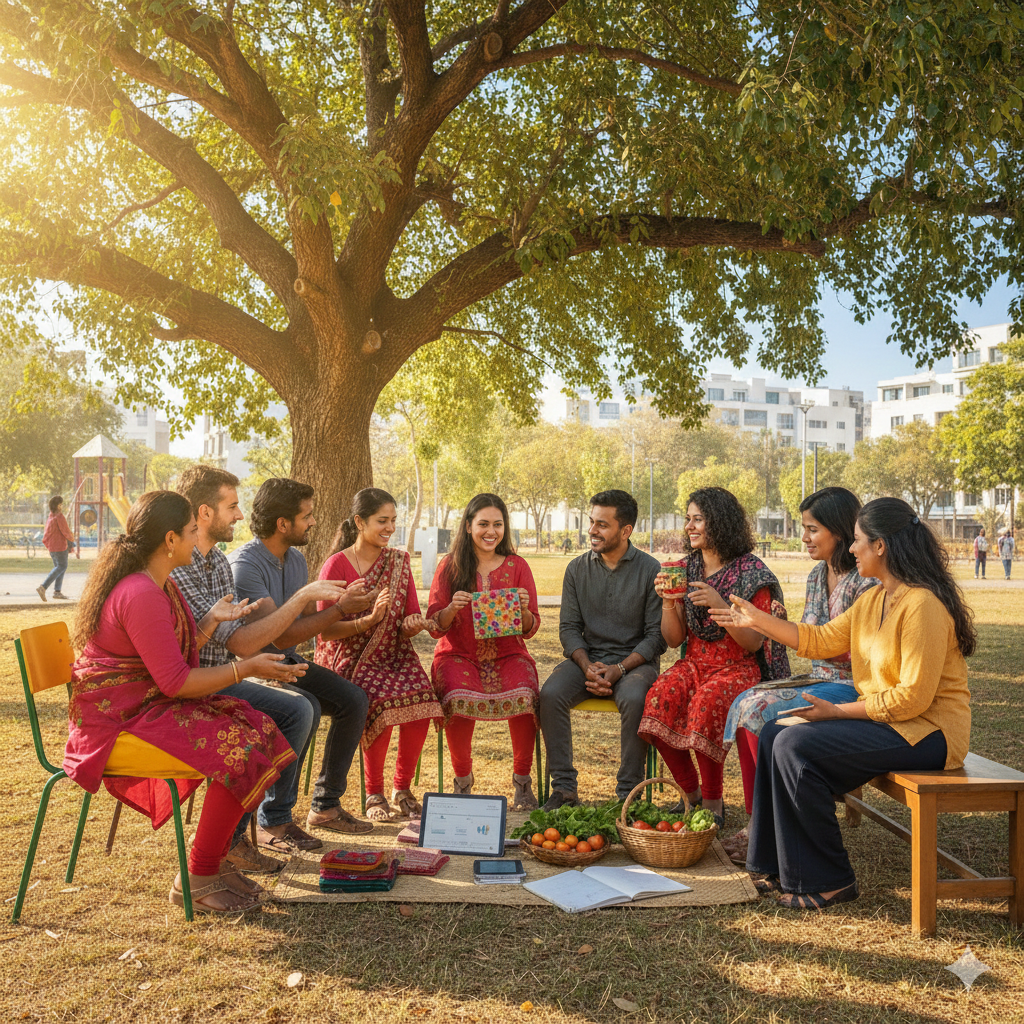
Self-Help Groups are small, informal, and voluntary collectives, usually comprising 10–20 members, often women from similar socio-economic backgrounds. Members pool small savings on a regular basis, create a common fund, and extend loans to one another for productive and consumption needs.
The core principles of SHGs include:
- Mutual trust and collective responsibility
- Financial discipline through regular savings
- Democratic decision-making
- Emphasis on self-reliance rather than dependency
Over time, SHGs have evolved from simple savings and credit groups into multi-dimensional development institutions.
Emergence of SHGs in Contemporary Times
The rise of SHGs coincides with broader changes in development governance, including:
- Decentralization and community participation
- Recognition of limits of top-down state-led development
- Focus on financial inclusion and micro-entrepreneurship
- Involvement of civil society and non-state actors
In this context, SHGs have been promoted as vehicles for inclusive growth, especially in rural and marginalized regions.
Examining the Claim of State Withdrawal
The assertion that SHGs indicate a withdrawal of the State must be understood carefully.
From Direct Provider to Facilitator
Rather than a complete withdrawal, the State’s role has increasingly shifted from direct service delivery to facilitation, capacity-building, and regulation. SHGs often operate within frameworks designed, funded, and monitored by the government.
Addressing Governance Gaps
SHGs have emerged strongly in areas where state capacity has historically been weak. Their presence highlights governance gaps but also reflects an attempt to bridge those gaps through community-based mechanisms.
Thus, SHGs are not evidence of abdication, but of adaptive governance in response to complex development challenges.
Role of SHGs in Development Activities
Financial Inclusion and Credit Access
One of the most significant contributions of SHGs is the expansion of financial inclusion. By mobilizing savings and facilitating access to institutional credit, SHGs reduce dependence on informal moneylenders and improve financial literacy.
This role is particularly important for women, landless labourers, and marginalized communities.
Livelihood Generation and Economic Empowerment
SHGs support income-generating activities such as:
- Agriculture and allied activities
- Handicrafts and cottage industries
- Small-scale enterprises and services
Through collective bargaining and entrepreneurship, SHGs enhance income stability and economic resilience.
Women’s Empowerment and Social Transformation
SHGs have emerged as powerful platforms for women’s empowerment by:
- Increasing control over financial resources
- Enhancing decision-making capacity within households
- Improving mobility and public participation
Social issues such as domestic violence, child marriage, health, and education are increasingly addressed through SHG forums.
Social Capital and Community Development
SHGs strengthen social capital by fostering trust, cooperation, and collective action. They often engage in:
- Village development planning
- Monitoring of public services
- Community infrastructure maintenance
This contributes to participatory development and local accountability.
Role in Governance and Service Delivery
In many regions, SHGs assist in implementing and monitoring government programs related to nutrition, sanitation, health, and education. Their proximity to beneficiaries enhances outreach and effectiveness.
Limitations of SHGs as Development Actors
Despite their contributions, SHGs face constraints:
- Uneven quality and sustainability
- Limited managerial and technical capacity
- Over-dependence on external funding or facilitation
- Risk of elite capture or exclusion
These limitations suggest that SHGs cannot replace the State but can complement it.
Measures Taken by the Government of India to Promote SHGs
National Livelihoods Mission (NRLM)
The National Rural Livelihoods Mission is the flagship program for promoting SHGs. It focuses on:
- Universal social mobilization
- Capacity building and financial inclusion
- Livelihood diversification
NRLM positions SHGs as central actors in rural poverty reduction.
SHG–Bank Linkage Program
This program facilitates direct access of SHGs to formal banking institutions, reducing transaction costs and improving credit flow.
Support for Women-Led SHGs
The government emphasizes women’s SHGs as instruments of gender empowerment. Support includes training, market access, and financial incentives.
Role in Social Sector Programs
SHGs are increasingly integrated into programs related to nutrition, sanitation, and health awareness, enhancing last-mile delivery.
Digital and Institutional Support
Digital platforms and federations at cluster and block levels strengthen governance, transparency, and sustainability of SHGs.
Critical Evaluation of Government Support
While government support has expanded SHG coverage, challenges remain:
- Administrative burden on SHGs
- Inconsistent quality of training
- Regional disparities in performance
Nevertheless, state support remains essential for scaling and sustaining SHGs.
Are SHGs Replacing or Reinforcing the State?
A nuanced assessment suggests that SHGs:
- Do not replace the State, as they lack authority, resources, and universality
- Reinforce governance by improving outreach, accountability, and participation
- Represent a hybrid development model combining state support with community initiative
Thus, their emergence reflects reconfiguration rather than withdrawal of the State.
Way Forward: Strengthening SHGs as Partners in Development
Capacity Building and Skill Development
Continuous training in financial management, leadership, and entrepreneurship is crucial.
Ensuring Inclusivity
Special efforts are needed to include the poorest and most marginalized groups.
Strengthening Federations
Strong SHG federations can enhance bargaining power, sustainability, and policy engagement.
Clear Role Definition
SHGs should complement, not substitute, core state responsibilities in health, education, and welfare.
Conclusion
The emergence of Self-Help Groups in contemporary India highlights a significant shift in development thinking—from top-down, state-centric models to participatory and community-driven approaches. While their growth may appear to signal a withdrawal of the State, a closer examination reveals a transformation in the State’s role from provider to enabler.
SHGs have played a vital role in financial inclusion, livelihood generation, women’s empowerment, and grassroots governance. At the same time, their effectiveness depends heavily on supportive state policies, institutional frameworks, and continuous capacity building.
Therefore, SHGs should be seen not as substitutes for the State, but as strategic partners in inclusive and sustainable development. A balanced approach that combines state responsibility with community initiative offers the most promising path forward.