Introduction
India is undergoing a profound transformation in how electricity is produced, managed, and consumed. For decades, power generation followed a centralised model: large thermal or hydro plants produced electricity, which travelled hundreds of kilometres before reaching consumers. While this system enabled industrialisation, it also created vulnerabilities — transmission losses, regional imbalances, dependence on fossil fuels, and limited access in remote areas.
Today, a new paradigm is emerging. Small-scale renewable installations such as rooftop solar, village microgrids, biomass units, and decentralised wind systems are reshaping the energy landscape. This approach is broadly described as Distributed Renewable Energy (DRE).
At the same time, Artificial Intelligence (AI) is becoming a powerful tool for managing complex systems. When combined with decentralised energy, AI enables intelligent forecasting, automated control, predictive maintenance, and consumer participation — capabilities that traditional grids cannot offer.
Together, AI and DRE represent not just a technological upgrade, but a systemic redesign of India’s electricity architecture.
Understanding Distributed Renewable Energy (DRE)
Distributed Renewable Energy refers to electricity generated close to where it is used, typically through small or medium-scale renewable sources.
These systems may operate:
- Independently (off-grid),
- In coordination with the main grid,
- Or as part of hybrid microgrids.
Common DRE applications include:
- Rooftop solar on homes and offices
- Solar mini-grids in rural clusters
- Biomass plants using agricultural residue
- Decentralised wind turbines
- Solar irrigation pumps
Unlike conventional power plants, DRE systems are:
- Modular
- Locally embedded
- Often community-owned or privately operated
- Scalable in small increments
This decentralised nature improves energy access and resilience but also introduces operational complexity — especially when thousands or millions of small generators interact with the grid simultaneously.
This is precisely where AI becomes indispensable.
Why India Needs Distributed Energy Systems
India’s energy challenges are unique in scale and diversity:
- Rapid urbanisation is increasing peak electricity demand.
- Rural and remote regions still face reliability gaps.
- Climate commitments require deep decarbonisation.
- Transmission infrastructure struggles to keep pace with generation expansion.
- Extreme weather events are stressing centralised grids.
Distributed renewable energy addresses many of these issues by:
- Reducing dependence on long-distance transmission
- Improving local energy security
- Enabling faster deployment compared to large power plants
- Supporting disaster resilience through localised supply
- Allowing citizens to become producers (“prosumers”)
India already has ambitious renewable targets supported by institutions such as Ministry of New and Renewable Energy, but capacity addition alone is insufficient. Managing decentralised assets requires intelligence — digital intelligence.
The Role of Artificial Intelligence in Modern Power Systems
Traditional electricity grids operate using static rules and manual intervention. AI transforms this by enabling real-time learning and autonomous optimisation.
In energy systems, AI can perform several critical functions:
1. Generation Forecasting
Solar and wind output fluctuate with weather. AI models use satellite data, historical patterns, and meteorological inputs to predict generation hours or days in advance. This helps grid operators prepare for variability.
2. Demand Prediction
Consumption patterns vary by season, region, and time of day. AI analyses usage data to anticipate demand spikes and troughs, improving load planning.
3. Smart Dispatch
AI algorithms decide which energy sources should supply power at any moment — balancing cost, availability, and grid stability.
4. Predictive Maintenance
Sensors embedded in panels, inverters, and transformers feed data to AI systems that detect early signs of equipment failure, reducing downtime.
5. Automated Energy Trading
In advanced setups, AI enables peer-to-peer electricity exchange between households and businesses through digital platforms.
Without AI, managing millions of decentralised generators would be nearly impossible.
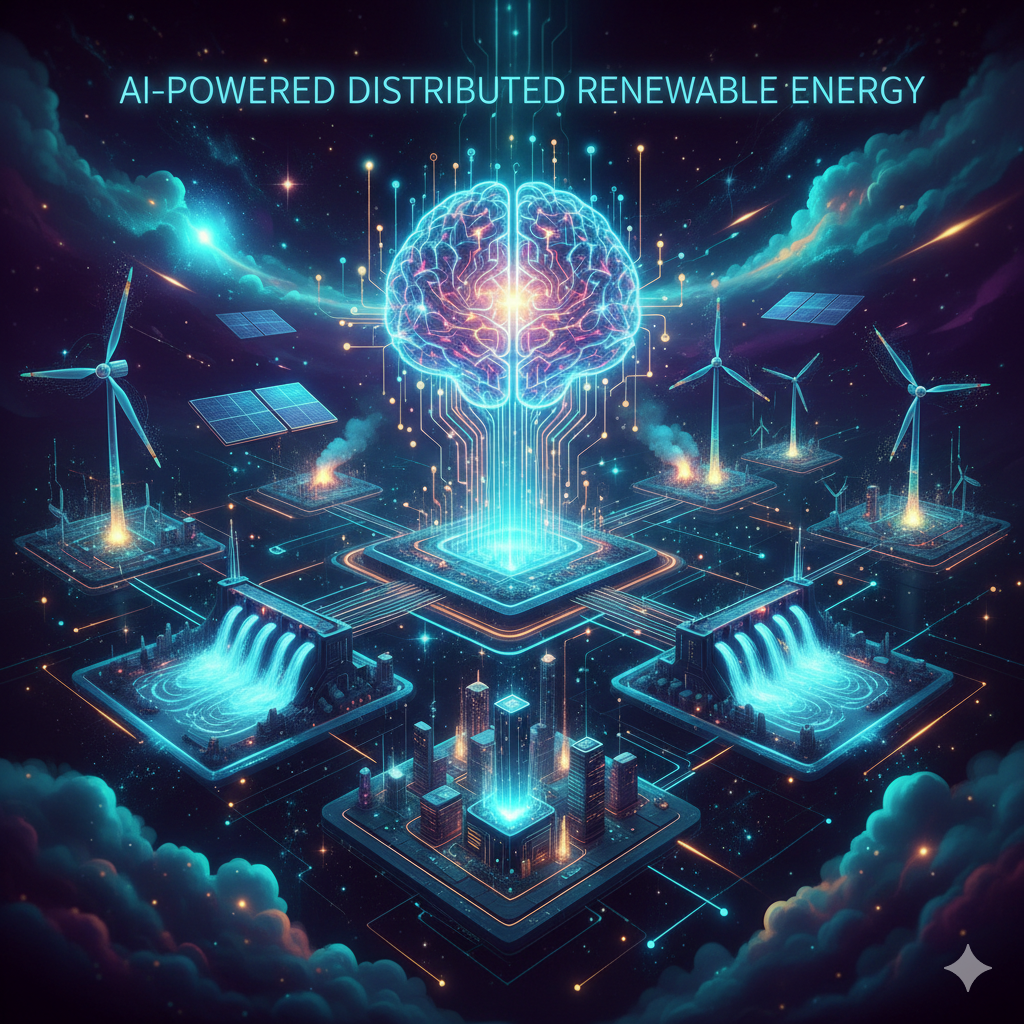
From Centralised Grids to Intelligent Energy Networks
India’s legacy grid was built for one-way electricity flow: from power station to consumer.
Distributed energy reverses this logic.
Homes, schools, factories, and farms now inject power back into the grid. This bidirectional flow creates a dynamic system that behaves more like a digital network than a mechanical utility.
To manage such complexity, the grid must evolve into an intelligent energy network — capable of:
- Self-diagnosis
- Adaptive routing
- Real-time optimisation
- Autonomous recovery
AI serves as the “operating system” of this new grid.
Digital Public Infrastructure for Energy
India has demonstrated global leadership in building open digital ecosystems through platforms like UPI and Aadhaar. A similar approach is now being envisioned for energy.
Policy institutions such as NITI Aayog have advocated for interoperable digital frameworks that allow devices, utilities, consumers, and markets to communicate seamlessly.
Such an Energy Digital Stack could include:
- Unified data standards
- Open APIs
- Secure identity systems for devices and users
- AI-driven analytics layers
- Market platforms for distributed energy exchange
This would prevent monopolisation by proprietary platforms and encourage innovation by startups, utilities, and local developers.
Citizen-Centric Energy: From Consumers to Prosumers
One of the most transformative aspects of AI-enabled DRE is the empowerment of citizens.
Households with rooftop solar are no longer passive users. With smart meters and AI platforms, they can:
- Track real-time consumption
- Optimise appliance usage
- Store energy in batteries
- Sell surplus electricity
- Participate in demand response programs
Farmers using solar pumps can schedule irrigation based on AI-predicted sunshine. Small businesses can reduce bills through automated load shifting.
This shift fundamentally democratizes energy.
Economic Implications
AI-driven distributed energy systems can unlock significant economic benefits:
Lower System Costs
Optimised dispatch reduces reliance on expensive peaking power plants.
Reduced Transmission Losses
Local generation means less electricity wasted over long distances.
Improved Reliability
Microgrids supported by AI can operate independently during blackouts.
New Employment Opportunities
Demand rises for data scientists, energy analysts, system integrators, and renewable technicians.
Startup Ecosystems
AI-energy convergence creates fertile ground for innovation in software, hardware, and services.
Challenges to Large-Scale Adoption
Despite immense promise, several obstacles remain.
1. Financial Stress of Distribution Companies
Many state electricity utilities struggle with debt, limiting investment in digital upgrades.
2. Infrastructure Gaps
Smart grids require sensors, communication networks, and automation equipment — not yet universally available.
3. Skills Shortage
Energy AI requires interdisciplinary expertise combining power engineering and data science.
4. Cybersecurity Risks
Digitised grids are vulnerable to hacking, necessitating strong protection frameworks.
5. Regulatory Readiness
Existing electricity laws were designed for centralised systems and must evolve to accommodate peer-to-peer trading and decentralised markets.
Environmental Significance
Beyond economics, AI-powered DRE directly supports climate goals by:
- Increasing renewable penetration
- Minimising curtailment of clean energy
- Reducing fossil fuel backup requirements
- Supporting electrification of transport and cooking
- Enabling precise energy efficiency measures
AI also helps measure emissions in real time, enabling transparent climate accounting.
Global Context and India’s Opportunity
Countries worldwide are experimenting with smart grids and decentralised renewables. However, India’s scale gives it a unique opportunity to pioneer inclusive models suitable for developing economies.
Rather than importing closed technologies, India can build open, affordable, and exportable AI-energy solutions — particularly relevant for Africa, Southeast Asia, and Latin America.
This aligns with India’s broader vision of technological self-reliance and South-South cooperation.
Policy Direction and Institutional Support
Multiple government bodies are converging on this agenda, including:
- Ministry of Power
- Central Electricity Authority
- Bureau of Energy Efficiency
Their collective focus is shifting from mere capacity addition to system intelligence.
Key priorities include:
- Smart meter rollout
- Grid modernisation
- Promotion of storage technologies
- Regulatory sandboxes for energy innovation
- AI skill development
The Road Ahead
For AI-powered DRE to reach maturity, India must pursue a coordinated strategy:
- Modernise distribution infrastructure
- Promote open digital standards
- Strengthen cybersecurity governance
- Support domestic AI startups
- Reform electricity regulations
- Integrate energy planning with climate policy
- Expand training programs in power analytics
These steps will determine whether decentralised renewables remain fragmented assets or become an integrated national system.
Conclusion
Artificial Intelligence and Distributed Renewable Energy together represent a structural shift in how India thinks about power.
This is not merely about cleaner electricity. It is about redesigning the energy system to be:
- Smarter
- More democratic
- More resilient
- More efficient
- Environmentally sustainable
If implemented thoughtfully, AI-enabled DRE can turn every rooftop, village, and enterprise into an active participant in India’s energy future.
Rather than a centralised utility model inherited from the industrial age, India now has the opportunity to build a networked, intelligent, citizen-driven power system — one that aligns economic growth with environmental responsibility.
This transformation, if achieved, will stand among the most significant infrastructure revolutions of the 21st century.