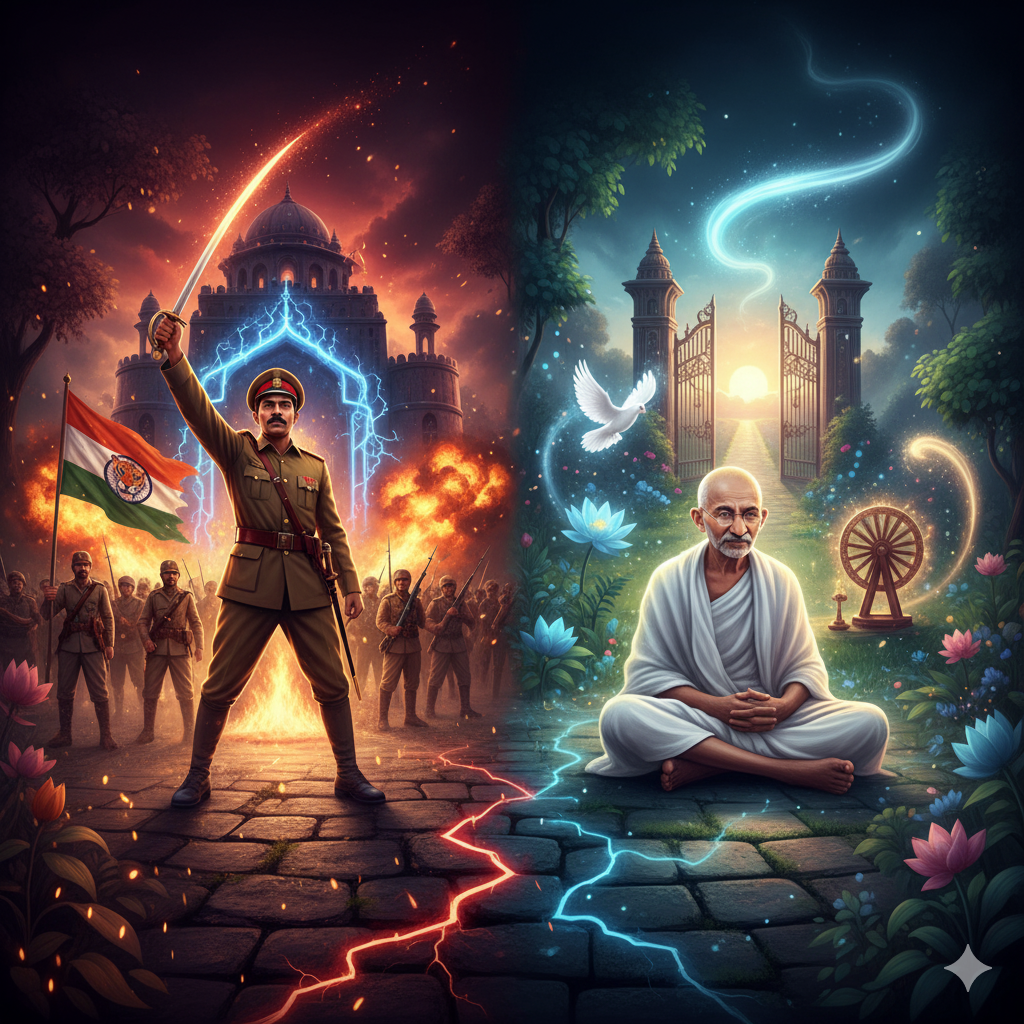
The Indian freedom movement was not a uniform political project. It was shaped by a wide spectrum of ideologies, strategies, and personalities. Among these, Mahatma Gandhi and Subhas Chandra Bose stand out as two towering figures—each equally committed to India’s liberation, yet dramatically different in their methods, philosophies, and interpretations of freedom. Their contrasting approaches enriched the freedom movement by bringing multiple dimensions—moral, political, militant, diplomatic, and international—to India’s struggle.
While Gandhi relied on non-violent mass mobilization, Bose believed in violent resistance backed by international alliances. While Gandhi drew strength from ethical persuasion, Bose emphasized military confrontation and strategic cooperation with foreign powers. Despite their differences, both contributed immensely to the overthrow of British rule, and their combined impact helped define the contours of India’s nationalist consciousness.
This essay highlights the major differences between their ideologies, strategies, leadership styles, political methods, and international roles, while also analyzing how their visions ultimately complemented each other in the larger national movement.
1. Introduction: Two Patriotic Visions, One Goal
Both Mahatma Gandhi and Subhas Chandra Bose dedicated their lives to the cause of India’s independence. However:
- Gandhi brought the struggle into the realm of Satyagraha, non-violence, mass awakening, and moral politics.
- Bose mobilized national sentiment toward armed struggle, revolutionary nationalism, and global diplomacy aimed at weakening Britain militarily.
Both leaders admired each other’s patriotism, yet differed fundamentally in:
- Political methods
- Moral philosophy
- International strategy
- Attitude toward violence
- Organizational preferences
- Relationship with the Indian National Congress
- Approach to achieving self-rule
Understanding their differences provides deeper insight into the diversity of India’s anti-colonial movements.
2. Philosophical Foundations: Non-Violence vs. Revolutionary Militarism
The first and most prominent difference between Gandhi and Bose lies in their philosophical worldview.
2.1 Gandhi’s Philosophy: Ahimsa and Satyagraha
Gandhi believed:
- Non-violence was not just a strategy, but a moral principle.
- Non-violence could win over the oppressor by appealing to conscience.
- Moral purity was essential for political legitimacy.
- Violence only created cycles of hatred.
He viewed Indian freedom as inseparable from:
- Ethical conduct
- Social reform
- Upliftment of rural society
- Communal harmony
- Truthfulness in public life
Thus, for Gandhi, means were as important as the ends.
2.2 Bose’s Philosophy: Militant Nationalism and Pragmatism
Bose rejected non-violence as a universal or absolute principle. He argued:
- Violence was justified when fighting foreign oppression.
- National freedom required military strength, not moral persuasion.
- Ethics must be balanced with practical considerations.
- A modern nation-state needed discipline, unity, and centralized leadership.
For Bose:
- Ends justified the means, as long as the goal was national liberation.
- Force was a legitimate tool against imperialism.
- Non-violence weakened the spirit of resistance.
Thus, Bose’s ideology aligned more with revolutionary nationalism, influenced by leaders like Vivekananda, Aurobindo, and Italian and Irish freedom fighters.
3. Method of Struggle: Non-Cooperation vs. Armed Struggle
Their philosophies shaped their radically different political strategies.
3.1 Gandhi’s Method: Mass Civil Disobedience
Gandhi believed in mobilizing the masses through:
- Non-Cooperation Movement (1920–22)
- Civil Disobedience Movement (1930–34)
- Quit India Movement (1942)
He emphasized:
- Boycotting foreign goods
- Refusing to pay taxes
- Non-violent marches
- Peaceful protests
- Constructive programmes like promoting khadi, education, sanitation
Gandhi’s method sought to paralyze the colonial administration without using violence.
3.2 Bose’s Method: Military Confrontation
Bose rejected the idea that peaceful protests alone could defeat the British Empire. He preferred:
- Organizing an armed revolt
- Seeking foreign military support
- Creating a professional Indian army
- Using diplomacy to exploit Britain’s wartime weakness
His initiatives include:
- Leading the Forward Bloc (1939–40)
- Escaping to Europe in 1941
- Forming the Azad Hind Government (1943)
- Reorganizing the Indian National Army (INA)
- Fighting alongside the Japanese forces in Burma and Imphal
He believed that the British could be defeated only through forceful confrontation, not negotiation.
4. Approach to the British Empire
4.1 Gandhi: British Rule Must Be Resisted Morally
Gandhi held:
- The British Empire could be morally compelled to leave.
- Indians must show they were capable of self-rule through discipline and non-violence.
- Cooperation with the British system must be withdrawn, but hatred was unacceptable.
- The fight was against imperialism, not the British people.
Thus, Gandhi maintained moral opposition rather than hostility.
4.2 Bose: British Rule Must Be Destroyed Militarily
Bose believed:
- The British were imperial predators who would never leave voluntarily.
- Only military action or violent uprising could expel them.
- India must exploit Britain’s military vulnerabilities during World War II.
- Hostile alliances against Britain were not only justified but necessary.
Thus, Bose adopted an anti-British military position rather than a moral one.
5. Role of Masses and Organization
5.1 Gandhi: Trust in the People
Gandhi’s leadership rested on:
- Mobilizing ordinary Indians—peasants, women, workers.
- Empowering the weakest sections of society.
- Decentralization and village-based organization.
- Building a mass movement rooted in moral discipline.
He democratized politics by connecting with every segment of society.
5.2 Bose: Centralized and Military-Style Leadership
Bose emphasized:
- Strong centralized authority
- Military discipline and hierarchy
- Complete loyalty to leadership
- Modern organization based on efficiency, not mass spontaneity
While Gandhi wanted to empower the masses, Bose wanted to mobilize them under strong leadership.
6. Relationship with the Indian National Congress
6.1 Gandhi: The Moral Core of Congress
Gandhi shaped Congress into:
- A mass movement
- A broad-based coalition
- A democratic organization
He unified diverse groups—moderates, radicals, peasants, business class—into a single non-violent movement.
6.2 Bose: Radical Within Congress, Later Opposition
Bose rose quickly within Congress:
- Elected President in 1938 and again in 1939.
- Advocated immediate struggle instead of negotiations.
- Called for socialist economic reconstruction.
However:
- He differed with Gandhi and the right wing of Congress.
- He resigned from the presidency in 1939.
- Formed the Forward Bloc within Congress.
His radical approach clashed with Congress’s moderate and Gandhian leadership.
7. Attitude Toward International Alliances
Another major difference lies in their diplomatic approaches.
7.1 Gandhi: Neutrality in Global Conflicts
Gandhi believed:
- India should not exploit international rivalries.
- Alliances with fascist or authoritarian states were morally unacceptable.
- True freedom must be based on ethical principles.
He opposed India’s participation in World War II without consent, but rejected opportunistic alliances.
7.2 Bose: Alliances with Axis Powers for India’s Liberation
Bose’s international strategy was pragmatic:
- “The enemy of my enemy is my friend.”
- Sought support from Germany, Italy, and Japan.
- Formed the Azad Hind Government with Japanese backing.
- Viewed World War II as a historic opportunity.
His goal was not ideological alignment with fascism, but military assistance to liberate India.
8. Vision of Free India: Gandhian Village Swaraj vs. Bose’s Modern Industrial Nation
Their visions of post-independence India differed significantly.
8.1 Gandhi’s Vision: A Decentralized, Ethical Society
Gandhi’s ideal India would be:
- A federation of self-reliant villages
- Based on simplicity, manual labor, and moral values
- Free from industrial exploitation
- Rooted in swadeshi and Khadi
- Guided by truth, non-violence, and social harmony
His ideal was ethical, rural, decentralized, spiritual.
8.2 Bose’s Vision: A Modern, Industrialized, Socialist India
Bose’s dream for India included:
- Rapid industrialization
- State-led economic planning
- Strong central government
- Modern military establishment
- Scientific and technological development
- Equality and socialism
He admired the Soviet model and emphasized strong governance during nation-building.
His ideal was modern, industrial, centralized, militarily powerful.
9. Leadership Style and Personality
9.1 Gandhi: The Moral Leader
- Led through example and moral conduct
- Inspired trust and devotion
- Believed in persuasion rather than coercion
- Lived a life of simplicity and sacrifice
He was a spiritual-political leader, not a commander.
9.2 Bose: The Commanding Hero
- Charismatic, bold, and action-oriented
- Groomed as a military-style leader
- Inspired discipline rather than moral submission
- Admired for bravery, decisiveness, and patriotism
He was a military-political leader, not a mass spiritual guide.
10. Contribution to India’s Freedom: Complementary, Not Contradictory
Despite their differences, both leaders made immense contributions:
Gandhi’s Contributions
- Transformed nationalism into a mass movement
- Gave moral legitimacy to the struggle
- Strengthened national unity
- Weakened British authority through non-cooperation
Bose’s Contributions
- Internationalized India’s freedom struggle
- Inspired Indians with INA’s sacrifices
- Created military pressure on the British
- Encouraged revolutionary nationalism
Historians today acknowledge that:
- Gandhi weakened British will to rule.
- Bose weakened British ability to rule.
Both streams of nationalism—Gandhian non-violence and Bose’s armed resistance—combined to create irresistible momentum for independence.
11. Major Differences Summarized
| Aspect | Mahatma Gandhi | Subhas Chandra Bose |
|---|---|---|
| Philosophy | Non-violence (Ahimsa) and Satyagraha | Armed struggle and militant nationalism |
| Method | Mass civil disobedience | Military confrontation |
| Attitude to Violence | Opposed on moral grounds | Accepted as necessary |
| Organization | Decentralized, mass-based | Centralized, military-style |
| Relationship with Congress | Central guiding figure | Rebel within Congress, later broke away |
| International Alliances | Avoid alliances with imperialist powers | Supported alliances with Axis powers |
| Vision of Free India | Rural, decentralized, moral society | Modern, industrialized, socialist nation |
| Leadership Style | Moral and spiritual | Charismatic and authoritarian |
| Approach to British Rule | Moral pressure and negotiations | Total military defeat |
| Means vs Ends | Means equally important as ends | Ends more important than means |
12. Conclusion: Two Paths, One Goal
The struggle between non-violent and revolutionary approaches did not weaken the freedom movement; rather, it deepened and diversified the struggle. Gandhi and Bose represented two distinct but complementary visions:
- Gandhi symbolized moral resistance, democratic participation, and national unity.
- Bose embodied militant courage, global diplomacy, and assertive nationalism.
Their contrasting methods reflected the broader spectrum of Indian aspirations. While Gandhi mobilized millions within India, Bose mobilized thousands abroad. While Gandhi appealed to conscience, Bose appealed to courage. While Gandhi sought to transform society ethically, Bose sought to liberate it militarily.
Together, they created a powerful combination of mass awakening and militant resolve—a dual legacy that played a decisive role in shaking the foundations of British rule. Their differences illustrate the richness of India’s nationalist movement and continue to inspire debates on political ethics, leadership, and national identity.