Introduction
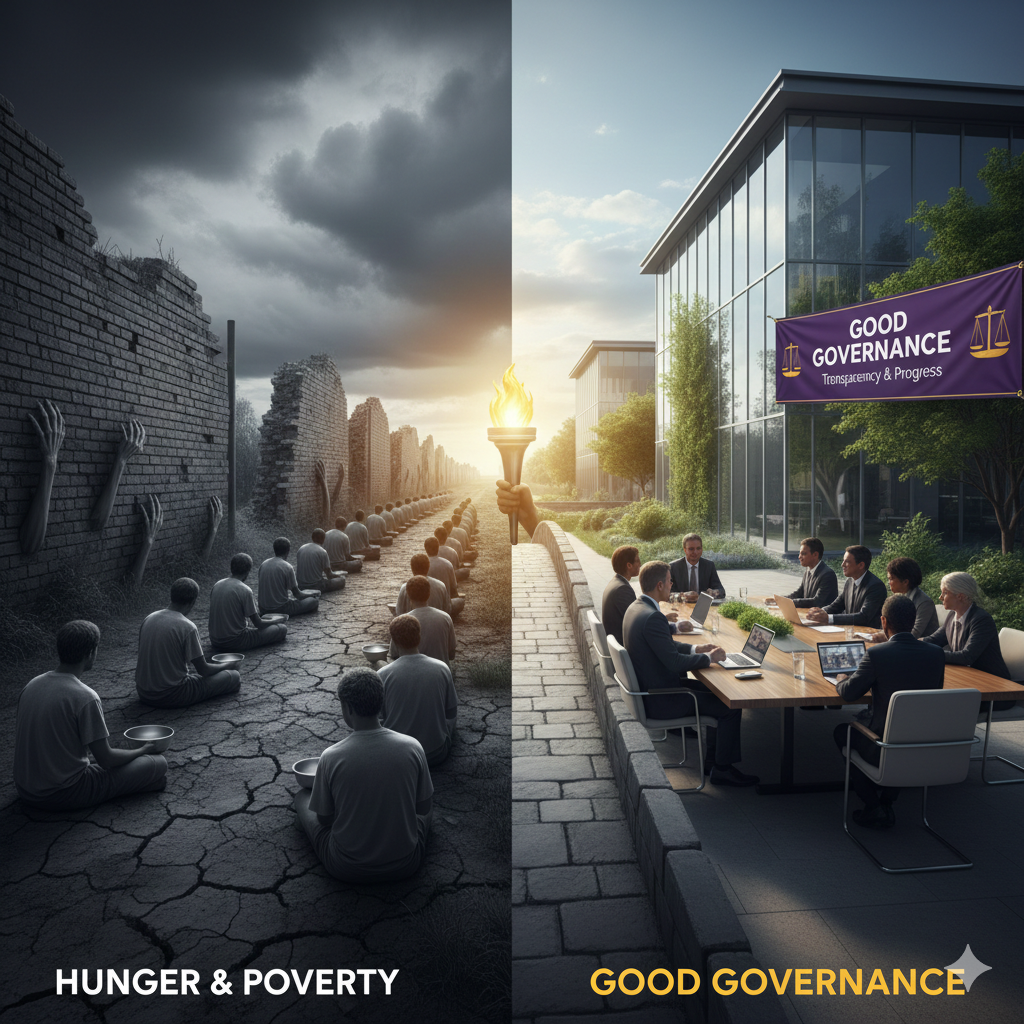
Good governance is not merely about efficient administration or robust institutions; it is ultimately judged by its ability to ensure a dignified life for all citizens. In India, despite decades of planned development and democratic governance, hunger and poverty continue to remain among the most serious challenges to good governance. These problems undermine human development, weaken social cohesion, and erode citizens’ trust in the state.
India has made notable progress in economic growth, technological advancement, and welfare expansion. Yet, the persistence of malnutrition, food insecurity, and income deprivation raises a fundamental question: How far have successive governments progressed in addressing hunger and poverty, and what more needs to be done to strengthen good governance?
This answer evaluates India’s efforts across different phases of governance and suggests measures for more effective and sustainable outcomes.
Hunger and Poverty: Why They Are Governance Challenges
Hunger as a Governance Failure
Hunger is not merely the absence of food but the inability to access adequate, nutritious, and safe food. In a country capable of producing surplus food grains, the persistence of hunger reflects issues of:
- Inequitable distribution
- Weak delivery mechanisms
- Poor targeting of beneficiaries
Hunger directly affects health, education, productivity, and human capital formation, making it a critical governance issue.
Poverty and Its Multidimensional Nature
Poverty in India is no longer seen only as income deprivation. It is multidimensional, encompassing lack of education, health services, housing, sanitation, and social security. Persistent poverty restricts citizens’ participation in governance and limits their capacity to claim rights and entitlements.
Thus, hunger and poverty together represent structural barriers to good governance, as they perpetuate inequality and exclusion.
Evolution of Government Efforts to Address Hunger and Poverty
Early Phase: State-Led Welfare and Food Security
In the initial decades after independence, the Indian state adopted a welfare-oriented and interventionist approach. Policies focused on:
- Expanding agricultural production
- Stabilizing food prices
- Ensuring minimum access to food
Public distribution systems and food procurement mechanisms were created to prevent famine-like situations. These measures helped India achieve food self-sufficiency and avoid large-scale starvation.
Evaluation:
While these efforts reduced extreme food shortages, they were often inefficient, urban-biased, and poorly targeted. Hunger persisted due to leakages and exclusion.
Reform Phase: Growth-Led Poverty Reduction
Economic reforms shifted the focus towards growth-driven poverty alleviation. Higher economic growth was expected to generate employment and incomes, thereby reducing poverty.
Several employment and social assistance programs were introduced to complement growth.
Evaluation:
Growth did contribute to poverty reduction, but its benefits were uneven. Hunger and malnutrition remained widespread, indicating that economic growth alone was insufficient to address human deprivation.
Rights-Based and Inclusive Governance Phase
In recent decades, India has increasingly adopted a rights-based approach to hunger and poverty. Policies have aimed at legal entitlements, transparency, and inclusion.
Key features include:
- Legal recognition of food and work as entitlements
- Direct benefit transfers to reduce leakages
- Emphasis on nutrition, sanitation, and health
Evaluation:
This phase marked a significant improvement in governance intent and design. However, implementation gaps continue to limit impact.
Assessment of Progress in Dealing with Hunger
Food Availability vs Food Access
India has largely succeeded in ensuring food availability at the national level. However, household-level access remains uneven due to poverty, migration, and social exclusion.
Nutrition Deficit
Hunger today manifests more as hidden hunger, including deficiencies of micronutrients. Despite improvements in food delivery, malnutrition among children and women remains a major concern.
Governance Outcomes
- Improved coverage of food support programs
- Better use of technology in beneficiary identification
- Yet, persistent regional and social disparities
Overall, progress has been moderate but incomplete.
Assessment of Progress in Poverty Reduction
Decline in Income Poverty
Successive governments have reduced income poverty levels through growth, employment programs, and social assistance. Many households have moved above basic income thresholds.
Multidimensional Poverty
Improvements in access to sanitation, housing, electricity, and financial inclusion indicate progress in reducing multidimensional poverty.
Governance Perspective
- Expansion of welfare architecture
- Increased use of digital governance
- But challenges of exclusion, informality, and job insecurity remain
Thus, while poverty reduction has advanced, quality of livelihoods and sustainability remain concerns.
Why Hunger and Poverty Persist Despite Policy Efforts
Implementation Deficit
Even well-designed policies suffer from weak last-mile delivery, administrative capacity constraints, and local-level corruption.
Social Inequality
Caste, gender, region, and disability intersect with poverty, making governance responses complex and uneven.
Informal Economy Dominance
A large informal workforce faces income instability, lack of social protection, and vulnerability to economic shocks.
Fragmented Governance
Multiple schemes across departments lead to duplication, inefficiency, and poor convergence.
Impact on Good Governance
Hunger and poverty weaken good governance by:
- Limiting citizen participation
- Increasing dependence on state patronage
- Reducing trust in public institutions
- Straining fiscal resources
Good governance requires empowered citizens; persistent deprivation undermines this foundation.
Measures for Improvement
Shift from Scheme-Based to Outcome-Based Governance
Governance should prioritize nutrition outcomes, livelihood security, and quality of life, not merely expenditure or coverage targets.
Strengthening Employment-Centric Growth
Sustainable poverty reduction requires decent jobs, especially in manufacturing, services, and rural non-farm sectors.
Addressing Nutrition Holistically
Hunger policies must integrate:
- Food security
- Health services
- Sanitation
- Women’s empowerment
A life-cycle approach is essential.
Improving Targeting and Inclusion
Dynamic beneficiary identification using local data and community participation can reduce exclusion and leakage.
Enhancing Federal and Local Capacity
Empowering local governments with resources and accountability improves responsiveness and contextual governance.
Strengthening Social Accountability
Social audits, transparency measures, and grievance redressal systems must be strengthened to ensure citizen oversight.
Role of Technology in Improving Governance Outcomes
Technology can enhance:
- Targeting and delivery
- Transparency and monitoring
- Financial inclusion
However, digital solutions must be inclusive to avoid new forms of exclusion.
Way Forward: Towards Human-Centric Governance
India’s experience shows that hunger and poverty are not merely economic problems but governance challenges requiring political commitment, institutional capacity, and social empathy.
Future strategies must focus on:
- Human development as the core objective
- Convergence of welfare, growth, and empowerment
- Long-term resilience rather than short-term relief
Conclusion
Hunger and poverty continue to pose serious challenges to good governance in India. Successive governments have made significant progress in reducing extreme deprivation, expanding welfare coverage, and adopting rights-based approaches. However, the persistence of malnutrition, livelihood insecurity, and inequality indicates that governance outcomes have not fully matched policy ambitions.
To strengthen good governance, India must move beyond incremental improvements and adopt a holistic, inclusive, and outcome-oriented approach. Addressing hunger and poverty is not only a moral obligation but also a prerequisite for democratic stability, economic sustainability, and social justice.
In essence, good governance in India will remain incomplete until freedom from hunger and poverty becomes a lived reality for all citizens.