Introduction
Flooding has become a recurring problem in Indian cities, affecting millions of residents annually. Even “smart cities” like Hyderabad and Pune, designed with modern infrastructure, have experienced devastating urban floods. The frequency, intensity, and economic impact of urban floods have increased due to climate change, unplanned urbanization, and poor drainage systems.
Urban floods are distinct from riverine floods as they occur due to stormwater accumulation, inadequate drainage, blocked waterways, and heavy rainfall events concentrated in small areas. The consequences are multi-dimensional: loss of lives, damage to property and infrastructure, disruption of transport, public health crises, and long-term socio-economic losses.
This essay examines the causes of massive urban flooding in India, including in smart cities, and proposes lasting remedial measures to mitigate future risks, drawing on lessons from national and international experiences.
The Phenomenon of Urban Flooding in India
Urban flooding refers to water accumulation in cities beyond normal levels, often triggered by rainfall that exceeds the drainage capacity. Unlike rural or riverine flooding, urban flooding is exacerbated by human interventions and poor urban planning.
Recent Examples
- Hyderabad (2020) – Heavy rains caused severe flooding, damaging homes and submerging streets in low-lying areas.
- Pune (2021) – Torrential rainfall led to inundation in urban areas, paralyzing traffic and disrupting essential services.
- Other cities such as Mumbai, Chennai, Bengaluru, and Patna have witnessed annual flood events due to similar factors.
These events highlight that even technologically advanced, well-planned urban centers are vulnerable.
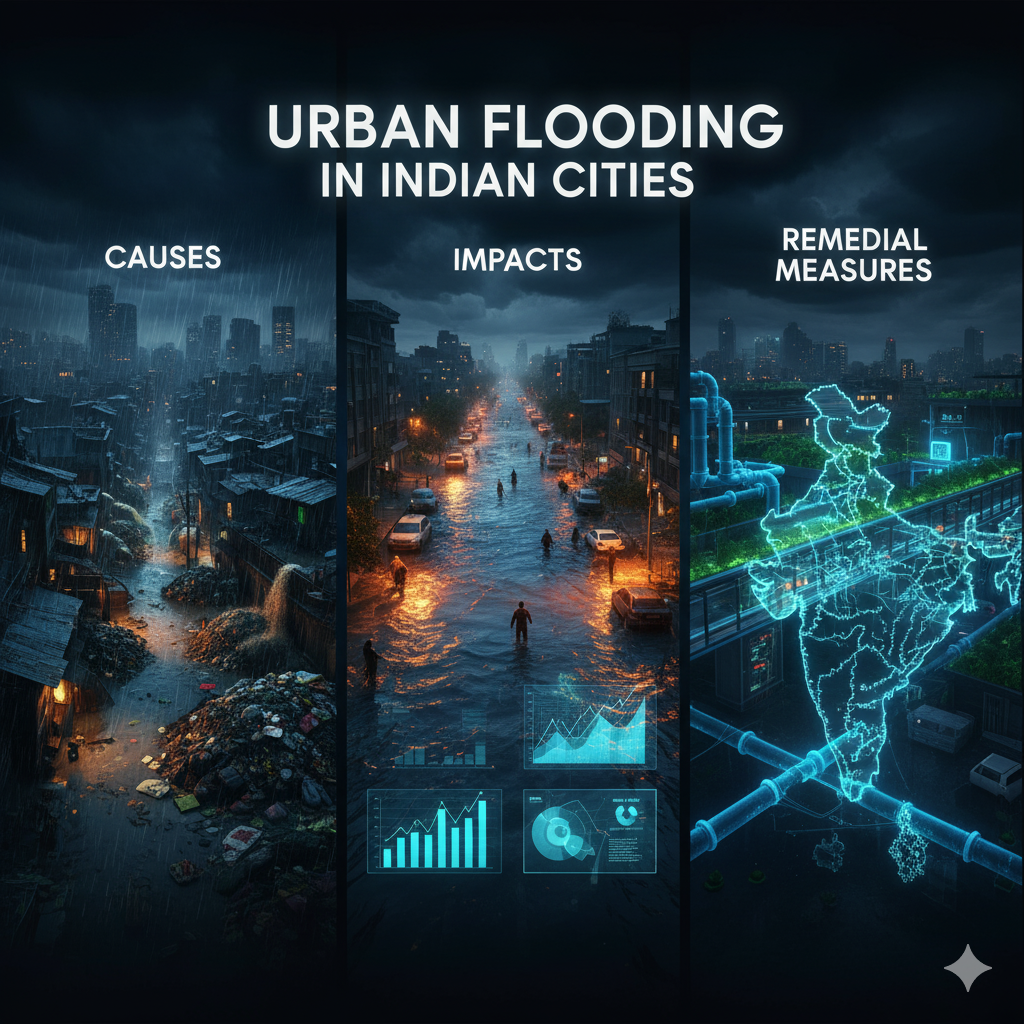
Causes of Urban Flooding in Indian Cities
Urban flooding in India is multi-causal, combining natural and human-induced factors.
1. Intense and Erratic Rainfall
- Climate change has increased the frequency of extreme rainfall events, particularly during the monsoon.
- Heavy precipitation in short durations overwhelms urban drainage systems.
- Example: Hyderabad experienced over 200 mm rainfall in 24 hours in 2020, causing rapid flooding.
2. Unplanned and Rapid Urbanization
- Expansion of cities has often been unplanned, with concrete surfaces replacing natural soil.
- Impervious surfaces prevent infiltration, increasing surface runoff.
- Encroachments on low-lying areas, wetlands, and natural drains reduce the city’s natural capacity to absorb water.
3. Poor Drainage Infrastructure
- Many Indian cities have old and inadequate drainage systems that cannot cope with increasing urban population and rainfall intensity.
- Blocked drains due to solid waste disposal exacerbate waterlogging.
- Example: Pune’s flood-prone areas often coincide with under-maintained stormwater drains.
4. River Encroachment and Loss of Floodplains
- Urban expansion often encroaches on riverbanks and natural floodplains, reducing storage and buffer capacity.
- Example: The Muslimwadi and Mula-Mutha rivers in Pune have seen encroachment and dumping, reducing flow capacity.
5. Insufficient Rainwater Harvesting and Groundwater Recharge
- Lack of functional rainwater harvesting structures in urban buildings reduces absorption.
- Groundwater depletion worsens water stagnation during heavy rains.
6. Climate Change and Global Warming
- Rising temperatures and altered monsoon patterns contribute to extreme rainfall events.
- Increased urban heat islands intensify local convection, producing localized heavy rainfall.
7. Inadequate Urban Planning and Governance
- Failure to integrate flood risk mapping and drainage planning in city master plans.
- Lack of inter-agency coordination between municipal corporations, state water boards, and disaster management authorities.
Impacts of Urban Flooding
1. Human Casualties and Health Risks
- Loss of life due to drowning and accidents.
- Waterborne diseases like cholera, dengue, and leptospirosis surge after floods.
2. Infrastructure Damage
- Roads, bridges, metro systems, and public utilities are severely affected.
- Example: Hyderabad metro and Pune’s suburban rail were disrupted during flood events.
3. Economic Losses
- Property damage, business disruption, and loss of agricultural or industrial output lead to huge economic costs.
- Insurance claims and emergency relief increase fiscal burdens.
4. Displacement and Social Disruption
- Floods cause temporary or permanent displacement of urban populations.
- Vulnerable populations in slums or low-lying areas suffer disproportionately.
5. Environmental Consequences
- Contamination of water bodies with sewage and industrial effluents.
- Soil erosion and degradation in flood-affected areas.
Case Studies
1. Hyderabad Floods (2020)
- Causes: Extreme rainfall, poor drainage, encroachment on stormwater channels, inadequate flood management.
- Impacts: 100+ deaths, thousands displaced, extensive property damage.
- Lesson: Need for modern drainage systems integrated with urban planning.
2. Pune Floods (2021)
- Causes: Intense rainfall, overflowing rivers, silted and blocked drains.
- Impacts: Traffic disruption, public transport stoppages, economic losses in industrial zones.
- Lesson: Emphasis on river restoration and floodplain management.
3. Chennai Floods (2015)
- Causes: Unplanned urban sprawl, destruction of wetlands, inadequate stormwater drains.
- Impacts: Massive inundation, deaths, economic losses over ₹20,000 crore.
- Lesson: Wetlands and urban water bodies must be preserved for flood resilience.
Lasting Remedial Measures
To prevent recurrent urban floods, a holistic, multi-pronged approach is required.
1. Improved Drainage and Stormwater Management
- Expand and modernize stormwater drainage networks.
- Regular desilting and cleaning of drains.
- Construction of detention basins and retention ponds to store excess rainwater temporarily.
2. Restoration of Urban Water Bodies and Wetlands
- Protect rivers, lakes, and wetlands within cities.
- Example: Restoring Hussain Sagar Lake (Hyderabad) and Pune’s Mula-Mutha floodplains can absorb excess runoff.
3. Rainwater Harvesting and Groundwater Recharge
- Mandate rooftop rainwater harvesting in all buildings.
- Implement permeable pavements in urban areas.
- Recharge aquifers to improve water absorption and reduce surface runoff.
4. Flood-Resilient Urban Planning
- Integrate flood risk zoning in city master plans.
- Avoid construction on natural floodplains and low-lying areas.
- Promote vertical expansion rather than horizontal sprawl to reduce impervious surfaces.
5. Early Warning Systems and Disaster Preparedness
- Deploy real-time rainfall and water level monitoring systems.
- Issue early flood warnings via SMS, apps, and social media.
- Conduct mock drills and community awareness programs.
6. River and Canal Restoration
- Desilt rivers and urban canals to enhance flow capacity.
- Remove encroachments and illegal dumping along riverbanks.
- Incorporate green belts and riparian buffers to stabilize banks and reduce flooding.
7. Climate Adaptation Measures
- Develop urban heat island mitigation strategies to reduce local convection-induced rainfall.
- Adopt sustainable urban design that accommodates stormwater infiltration.
- Integrate flood risk assessment into climate-resilient city planning.
8. Policy and Governance Reforms
- Empower municipal authorities to implement and enforce flood mitigation measures.
- Ensure inter-agency coordination between urban development, water resources, and disaster management departments.
- Encourage public-private partnerships for sustainable urban drainage projects.
9. Community Engagement
- Educate citizens about flood risks and waste management.
- Promote participatory urban water management programs.
- Encourage community monitoring of drains, canals, and water bodies.
International Lessons
1. Netherlands
- Advanced flood defense systems with canals, levees, and storm surge barriers.
- Integrated approach combining engineering, spatial planning, and community engagement.
2. Japan
- Urban flood tunnels and underground water storage in Tokyo mitigate flash floods.
- Real-time monitoring and warning systems reduce human and economic losses.
3. Singapore
- ABC Waters Programme integrates urban drainage with parks and green infrastructure.
- Promotes sustainable water absorption and flood mitigation within urban landscapes.
Indian cities can adopt similar technology-driven, ecosystem-based, and participatory approaches.
Challenges in Implementing Remedial Measures
- Funding and Investment – Modern drainage and restoration projects require high capital.
- Land Acquisition and Encroachment – Difficulties in acquiring urban land for flood mitigation infrastructure.
- Coordination Across Departments – Overlapping responsibilities often delay implementation.
- Climate Change Uncertainty – Increasing rainfall variability makes planning complex.
- Public Participation – Effective community engagement remains limited in many cities.
Conclusion
Urban flooding in Indian cities, including technologically advanced smart cities like Hyderabad and Pune, is a multi-dimensional problem resulting from climate variability, unplanned urbanization, inadequate drainage, river encroachment, and governance challenges.
Lasting solutions require a holistic, integrated approach:
- Modern drainage and stormwater management.
- Restoration of wetlands, rivers, and floodplains.
- Rainwater harvesting and groundwater recharge.
- Flood-resilient urban planning and climate adaptation.
- Policy reforms and public participation.
While challenges in funding, governance, and land acquisition exist, sustainable urban flood management is achievable through scientific planning, technology adoption, and community engagement. Implementing these measures will not only reduce the risk of recurring floods but also enhance urban resilience, public health, and economic sustainability, ensuring that India’s cities remain habitable and productive in the face of climate change.