1. Introduction
Climate change is one of the most pressing global challenges of the 21st century. Rapid industrialization, deforestation, urbanization, and the overuse of fossil fuels have resulted in rising greenhouse gas (GHG) emissions, global warming, extreme weather events, and ecosystem degradation. These changes pose severe threats to human health, agriculture, water resources, biodiversity, and energy security.
India, being one of the largest emerging economies, faces the dual challenge of pursuing rapid economic growth while ensuring environmental sustainability. In response to these challenges, the Government of India launched the National Action Plan on Climate Change (NAPCC) in 2008. The NAPCC serves as the country’s strategic framework to promote sustainable development while addressing climate change mitigation and adaptation.
The objectives of NAPCC are comprehensive, encompassing environmental, economic, and social dimensions of climate change. It outlines a set of missions, initiatives, and strategies aimed at reducing emissions, enhancing renewable energy adoption, promoting energy efficiency, and building climate-resilient ecosystems.
Understanding the objectives of the NAPCC is crucial for policymakers, researchers, students, and environmental enthusiasts, as it reflects India’s approach toward tackling climate change and promoting sustainable development.
2. Meaning and Significance of the NAPCC
What is the NAPCC?
The National Action Plan on Climate Change (NAPCC) is a policy initiative of the Government of India designed to integrate climate change concerns into India’s development agenda. It focuses on both mitigation (reducing greenhouse gas emissions) and adaptation (strengthening resilience to climate impacts).
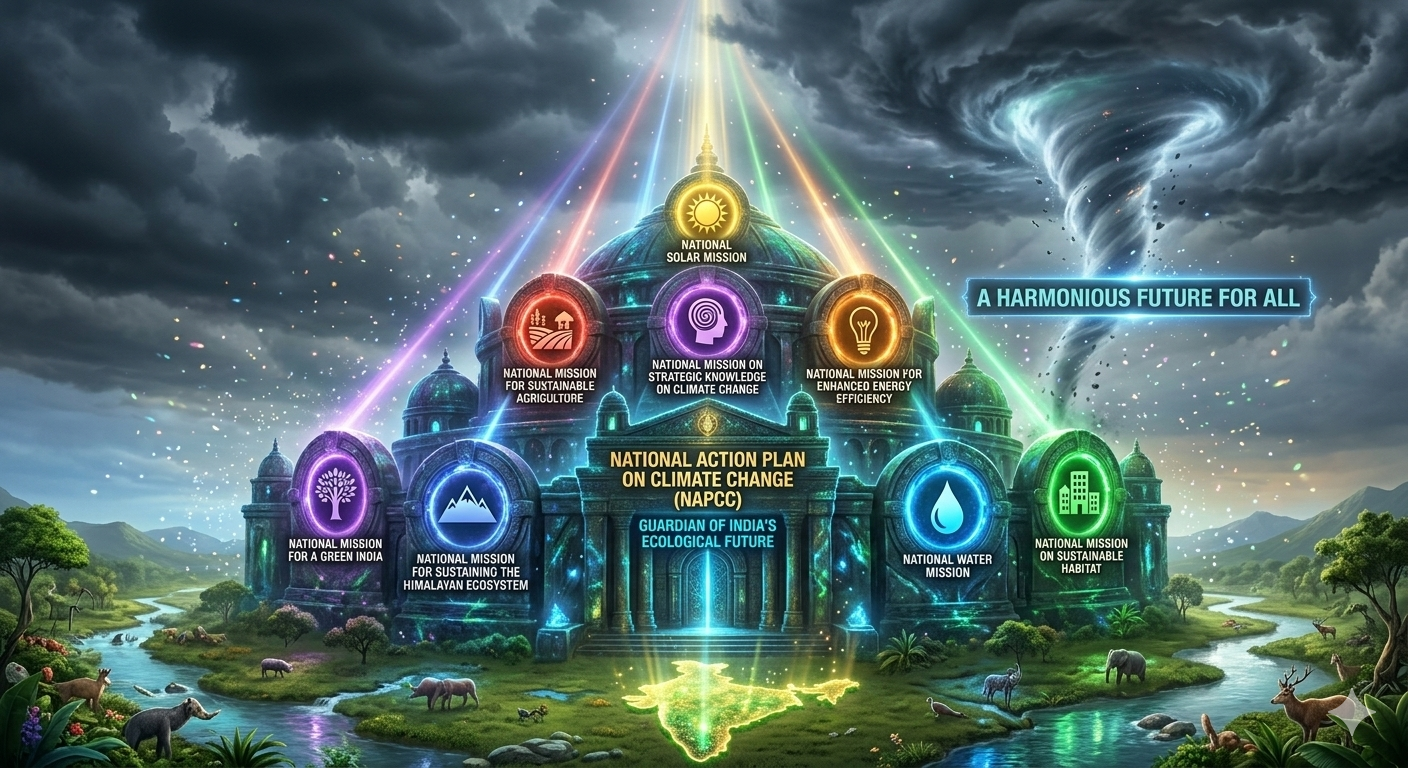
The NAPCC is implemented through eight national missions, each targeting specific areas such as solar energy, energy efficiency, sustainable agriculture, and water conservation. In addition, it promotes state-level action plans (SAPCCs) to ensure regional adaptation strategies.
Significance of the NAPCC
- Provides a framework for coordinated action across sectors and states.
- Promotes low-carbon growth while supporting economic development.
- Enhances energy security through renewable energy adoption.
- Improves climate resilience of vulnerable communities and ecosystems.
- Aligns India’s climate policies with international climate agreements.
3. Core Objectives of the NAPCC
The NAPCC’s objectives are multidimensional, focusing on mitigation, adaptation, technology development, and policy integration. Each objective is designed to address specific climate change challenges.
3.1 Mitigation of Greenhouse Gas Emissions
The foremost objective of the NAPCC is to reduce India’s greenhouse gas emissions intensity. While India’s per capita emissions remain lower than global averages, rapid industrial and energy sector growth poses the risk of increased emissions.
Key Points:
- Promote energy efficiency in industrial, commercial, and residential sectors.
- Encourage adoption of renewable energy sources like solar, wind, and biomass.
- Implement carbon intensity reduction strategies in power generation and transport.
- Support clean technology development for sustainable industrial growth.
3.2 Promotion of Renewable Energy
Renewable energy forms a cornerstone of India’s climate strategy. The NAPCC emphasizes increasing renewable energy capacity to reduce dependence on fossil fuels.
Key Points:
- Develop large-scale solar energy projects under the National Solar Mission.
- Expand wind and biomass energy generation capacity.
- Promote off-grid renewable energy solutions for rural areas.
- Encourage research and development in renewable technologies to improve efficiency and affordability.
3.3 Enhancing Energy Efficiency
Energy efficiency reduces emissions while saving costs. The NAPCC seeks to optimize energy use across sectors through regulatory measures and market mechanisms.
Key Points:
- Implement energy efficiency standards for appliances, industries, and buildings.
- Promote energy audits in industrial and commercial establishments.
- Encourage energy-efficient lighting and appliances in households.
- Introduce fiscal incentives and carbon credit mechanisms to encourage energy savings.
3.4 Climate Adaptation and Resilience
Climate change disproportionately affects vulnerable communities and ecosystems. NAPCC emphasizes adaptation strategies to reduce risks from floods, droughts, extreme temperatures, and sea-level rise.
Key Points:
- Strengthen water resource management to ensure availability during droughts.
- Promote climate-resilient agriculture practices for farmers.
- Protect coastal areas, forests, and biodiversity hotspots from climate impacts.
- Develop early-warning systems and disaster management plans for climate hazards.
3.5 Sustainable Agriculture
Agriculture is highly sensitive to climate variability. The NAPCC includes the National Mission on Sustainable Agriculture (NMSA) to enhance productivity while reducing environmental impacts.
Key Points:
- Promote water-efficient irrigation systems such as drip and sprinkler irrigation.
- Encourage crop diversification and drought-resistant crop varieties.
- Support organic farming and soil health management practices.
- Reduce the use of chemical fertilizers and pesticides to mitigate greenhouse gas emissions.
3.6 Water Resource Management
Water scarcity is a critical issue in India. The NAPCC addresses the need for efficient and sustainable management of water resources.
Key Points:
- Implement watershed development and rainwater harvesting initiatives.
- Promote efficient water-use technologies in agriculture, industry, and urban areas.
- Restore and protect wetlands, rivers, and groundwater resources.
- Integrate water management strategies with climate adaptation planning.
3.7 Forest and Ecosystem Conservation
Forests and ecosystems play a vital role in carbon sequestration and climate regulation. The NAPCC promotes conservation and sustainable management of these natural assets.
Key Points:
- Increase forest cover through afforestation and reforestation programs.
- Protect biodiversity-rich areas and wildlife habitats.
- Implement eco-restoration projects in degraded ecosystems.
- Promote community-based forest management for sustainable livelihoods.
3.8 Promotion of Sustainable Urbanization
Urban areas contribute significantly to energy consumption and greenhouse gas emissions. The NAPCC seeks to promote low-carbon and sustainable urban development.
Key Points:
- Encourage green buildings and energy-efficient urban infrastructure.
- Expand public transportation systems to reduce vehicular emissions.
- Implement waste management strategies to reduce landfill and methane emissions.
- Promote urban green spaces to improve air quality and climate resilience.
3.9 Technology Development and Research
Innovation and technology are crucial for addressing climate challenges. NAPCC promotes the development and deployment of climate-friendly technologies.
Key Points:
- Support research in renewable energy, energy efficiency, and clean technology.
- Encourage public-private partnerships for technological innovation.
- Facilitate transfer of low-carbon technologies to industries and communities.
- Build capacity in climate modeling, monitoring, and assessment.
3.10 Public Awareness and Capacity Building
For effective climate action, public awareness and stakeholder participation are essential. The NAPCC emphasizes education, outreach, and capacity building.
Key Points:
- Conduct environmental education and awareness programs.
- Build technical and managerial capacity in government agencies and institutions.
- Promote community participation in climate mitigation and adaptation initiatives.
- Encourage behavioral changes for sustainable consumption and energy use.
4. Implementation Mechanism
National Missions
The NAPCC operates through eight core national missions, each focusing on specific climate-related challenges:
- National Solar Mission – promoting solar energy.
- National Mission for Enhanced Energy Efficiency (NMEEE) – promoting energy efficiency.
- National Mission on Sustainable Habitat (NMSH) – encouraging sustainable urban development.
- National Water Mission (NWM) – improving water use efficiency.
- National Mission for Sustaining the Himalayan Ecosystem (NMSHE) – conserving fragile Himalayan ecosystems.
- National Mission for a Green India (GIM) – afforestation and ecosystem restoration.
- National Mission on Sustainable Agriculture (NMSA) – promoting climate-resilient agriculture.
- National Mission on Strategic Knowledge for Climate Change (NMSKCC) – research and knowledge dissemination.
State Action Plans on Climate Change (SAPCCs)
The NAPCC framework requires states to develop State Action Plans on Climate Change (SAPCCs), integrating national objectives with regional priorities. This ensures that climate actions are context-specific and locally relevant.
Monitoring and Evaluation
The Ministry of Environment, Forest and Climate Change (MoEFCC) coordinates NAPCC implementation. Progress is monitored through periodic reports, audits, and indicators, ensuring transparency and accountability.
5. Importance of NAPCC Objectives
Integrating Development and Environment
The NAPCC demonstrates that economic development and environmental protection can be mutually reinforcing, promoting low-carbon growth and resilience.
Climate Change Mitigation
By focusing on renewable energy, energy efficiency, and emission reductions, the plan contributes significantly to global efforts to limit greenhouse gas emissions.
Enhancing Climate Resilience
Adaptation strategies under NAPCC protect vulnerable communities, ecosystems, and agriculture from the adverse effects of climate variability.
Supporting International Commitments
India’s NAPCC objectives align with international climate agreements such as the Paris Agreement, demonstrating India’s commitment to global climate action.
6. Challenges in Achieving NAPCC Objectives
Resource Constraints
Implementing NAPCC initiatives requires significant financial, technical, and human resources, which can be limited in developing regions.
Regional Disparities
Different states face diverse climate challenges, requiring tailored strategies that may complicate uniform policy implementation.
Technology and Innovation Gaps
Developing and deploying climate-friendly technologies at scale remains a challenge due to limited domestic capacity and high costs.
Public Awareness
Achieving sustainable behavioral changes requires mass awareness campaigns, which remain insufficient in many regions.
7. Future Prospects
Strengthening National Missions
Expanding and strengthening existing missions can improve efficiency, outreach, and impact.
Integrating Climate Goals with Development Planning
Future efforts should ensure that climate objectives are fully integrated into national and state-level development plans.
International Collaboration
Collaborating with global partners for technology transfer, financing, and knowledge sharing can accelerate the achievement of NAPCC objectives.
Capacity Building
Investing in training, education, and skill development can enhance the effectiveness of climate action at national and state levels.
8. Conclusion
The National Action Plan on Climate Change (NAPCC) is a landmark initiative that provides India with a strategic framework to address climate change challenges while promoting sustainable development. Its objectives cover mitigation, adaptation, renewable energy promotion, energy efficiency, water and forest conservation, sustainable agriculture, technology development, and public awareness.
The successful implementation of NAPCC objectives requires coordination between national and state governments, industries, civil society, and local communities. Despite challenges such as resource limitations, regional disparities, and technology gaps, the NAPCC provides a roadmap for achieving low-carbon growth and climate resilience.
By adhering to its objectives, India can secure its environmental future, enhance economic sustainability, and contribute meaningfully to global climate action, ensuring that development benefits both present and future generations.