Introduction
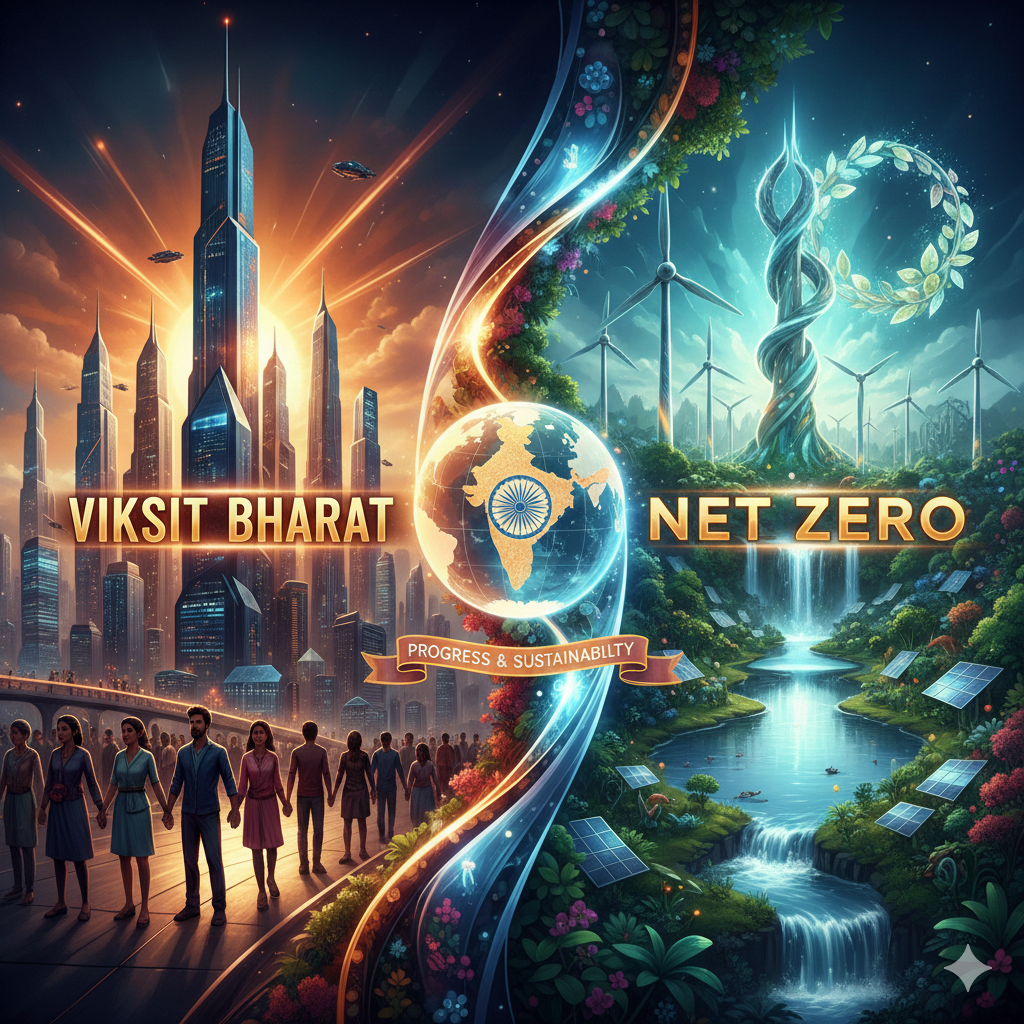
NITI Aayog — India’s premier policy think tank — has published a series of analytical reports envisioning long-term transformation pathways for India. Two interconnected visions are central:
- Viksit Bharat — A future where India becomes a developed and equitable nation by 2047 (100th year of Independence).
- Net Zero by 2070 — India’s commitment to reach net zero carbon emissions by 2070 as part of its climate goals.
These reports explore alternate scenarios, policy levers, economic trajectories, climate action pathways, and the interplay between development and sustainability. The goal is to inform policymakers, planners, civil society, and citizens about strategic choices that will shape India’s future.
Why These Reports Matter
- They integrate economic growth and environmental sustainability, two often competing policy priorities.
- They offer scenario modeling to help policymakers evaluate outcomes of different policy mixes.
- They anchor India’s development strategy in global climate goals and domestic aspirations.
Part I – Key Highlights of “Scenarios Towards Viksit Bharat and Net Zero”
The Aayog’s reports use scenario analysis to compare different future pathways based on policy choices. Instead of predicting a single outcome, they explore multiple feasible futures and outline what it takes to reach desirable endpoints.
1. Core Scenarios Defined
The reports typically construct three broad future scenarios:
| Scenario | Focus | Outcome Characteristics |
|---|---|---|
| Reference Scenario | Continuation of current policies | Slower economic transformation; higher energy intensity; delayed transition to renewables |
| Viksit Bharat Scenario | Pro-growth and pro-reform pathway | Higher GDP growth, increased human development, infrastructure expansion, improved quality of life indicators |
| Net Zero Scenario | Balanced development + deep decarbonisation | Strong climate action; renewable energy dominance; clean technologies; sustainable urbanization |
2. Economic Growth Projections
The scenarios present different GDP growth trajectories:
- Reference Scenario: India grows steadily but without structural transformation.
- Viksit Bharat Scenario: Higher productivity, digital transformation, manufacturing expansion, and human capital investments drive growth.
- Net Zero Scenario: Sustainable growth powered by green technologies and energy efficiency, balancing development with carbon constraints.
3. Decarbonisation Pathways
The reports map India’s journey from a coal-centric energy system to a renewable-dominated future:
- Coal remains a transition fuel in the short term.
- Renewable energy, nuclear power, and green hydrogen become major sources by mid-century.
- Carbon capture, utilization, and storage (CCUS) technology plays a role in abating emissions from hard-to-decarbonize sectors.
4. Energy Transition and Storage Needs
The reports identify transformational drivers:
- Massive scale-up of renewable energy installations.
- Grid modernization and smart energy systems.
- Energy storage infrastructure (batteries, pumped hydro) to balance renewable variability.
5. Sectoral Priorities
Transformation scenarios include sector-wise strategies for:
- Electricity & energy
- Industry & manufacturing
- Transport
- Agriculture
- Urban development
- Land use and forestry
Each sector has its own decarbonisation roadmap, reflecting India’s comparative advantages and resource endowments.
6. Investment Requirements
Achieving both development and sustainability goals demands huge investments:
| Investment Category | Indicative Scale | Purpose |
|---|---|---|
| Power-sector modernization | Multi-trillion USD | Renewable energy, grid expansion, storage |
| Transport electrification | High | EV infrastructure, charging network |
| Industrial decarbonisation | Large | Green technologies, CCUS |
| Digital infrastructure | Significant | Smart systems, data platforms |
| Climate adaptation & resilience | High | Coastal protection, disaster risk reduction |
These investments must come from a mix of public funds, private capital, and international climate finance.
7. Employment and Human Development
- Viksit Bharat scenarios emphasize job creation through manufacturing, services, and skills development.
- Net Zero pathways focus on green jobs, such as renewable energy installation, EV manufacturing, and energy efficiency services.
- Human capital investments (education, health, vocational training) are essential in both trajectories.
8. Policy and Regulatory Frameworks
The reports underscore enabling policy frameworks:
- Market-based instruments like carbon pricing.
- Renewable energy integration policies.
- Regulatory reforms for grid access, power markets, and resource efficiency.
- Strengthened research & innovation ecosystems.
9. Social Inclusion and Equity
Scenarios ensure that development is not just rapid but inclusive:
- Gender equity in workforce participation.
- Rural livelihood augmentation.
- Social protection for vulnerable populations.
- Regional parity in infrastructure and services.
10. Global Cooperation
Achieving net zero requires global technology transfer, climate finance support, and integration into global value chains. India’s role in climate diplomacy, coalitions like the International Solar Alliance, and engagements in G20 and COP processes are referenced.
Report Summaries
Executive Overview
- India’s development by 2047 and net zero by 2070 are complementary goals, not mutually exclusive.
- Bold policy actions today can yield long-term socioeconomic and environmental gains.
- Investments in clean energy will drive competitiveness and job creation.
Key Messages
- Strong institutions, stable policies, and market confidence are prerequisites for transformation.
- India’s demographic advantage must be harnessed through skill development.
- Private sector participation is crucial in green technologies.
Part II – Pathways to Strengthen India’s Journey Toward Viksit Bharat and Net Zero
Strategies to advance India’s missions can be grouped into policy directions, institutional reforms, technology adoption, finance mechanisms, and grassroots action.
1. Policy and Governance Reforms
A. Clear Strategy Alignment
Harmonize national development plans with net-zero commitments. This requires:
- Sectoral decarbonisation targets
- Renewable energy capacity goals
- Energy efficiency standards
- Fossil fuel transition pathways
B. Regulatory Stability
Signal long-term policy consistency to investors. Stable regulations reduce risk and mobilize private capital.
C. Inter-Ministerial Coordination
Cross-sectoral governance bodies should drive coherence between economic and environmental objectives.
2. Clean Energy Transition
A. Renewable Energy Scale-up
India must:
- Expand solar and wind capacity aggressively.
- Facilitate utility-scale and distributed generation.
- Encourage hybrid systems and microgrids.
B. Grid Modernization
Invest in digital grids, regional interconnectivity, and smart meters to handle variable power flows.
C. Storage and Flexibility
Deploy:
- Utility-scale batteries
- Pumped hydro storage
- Demand-response mechanisms
to ensure 24×7 reliability.
3. Transport Sector Transformation
A. Electrification
Accelerate adoption of electric vehicles in:
- Passenger cars
- Public transport
- Two-wheelers and three-wheelers
B. Charging Infrastructure
Build a network of fast chargers and battery swap stations.
C. Alternative Fuels
Promote biofuels and hydrogen fuel cell technologies where electrification is challenging.
4. Industrial Decarbonisation
A. Energy Efficiency
Mandate audits and efficiency standards for heavy industry.
B. Green Technologies
Support:
- Low-carbon steel production
- Carbon capture and storage
- Process electrification
C. Circular Economy
Encourage reuse, recycling, and material efficiency to reduce industrial footprints.
5. Agriculture and Land Use
A. Climate-Smart Agriculture
Deploy:
- Precision farming
- Efficient irrigation
- Soil carbon sequestration
B. Forestry and Ecosystem Services
Scale up afforestation and protect carbon sinks.
C. Methane Reduction
Improve livestock management and rice cultivation practices to curb methane emissions.
6. Urban Development and Buildings
A. Compact Cities
Promote high-density, transit-oriented development to reduce travel demand.
B. Green Buildings
Mandate energy-efficient construction and retrofit standards.
C. Waste Management
Implement comprehensive recycling and waste-to-energy programs.
7. Finance and Investment Mechanisms
A. Green Bonds
Leverage green bonds to fund sustainability projects.
B. Climate Funds
Access international climate finance to bridge investment gaps.
C. Public–Private Partnerships
Engage businesses through incentives and risk-sharing mechanisms.
8. Technology and Innovation
A. R&D Funding
Boost research into:
- Next-gen batteries
- Low-carbon materials
- Carbon removal technologies
B. Technology Diffusion
Facilitate transfer of climate technologies from global networks.
C. Digital Platforms
Use data analytics for real-time energy and emissions monitoring.
9. Human Capital and Skills
A. Education Reform
Integrate climate literacy into curricula.
B. Vocational Training
Equip the workforce with green skills.
C. Just Transition Programs
Support workers displaced from fossil fuel sectors with reskilling opportunities.
10. Social Inclusion and Participation
Promote community engagement in climate planning. Women, youth, and marginalised groups must be included in decision-making and benefits of transition.
Illustrative Summary Tables
Table 1: Scenario Comparison — Development vs Decarbonisation
| Dimension | Reference Scenario | Viksit Bharat | Net Zero 2070 |
|---|---|---|---|
| GDP Growth | Medium | High | Balanced with green growth |
| Energy Mix 2050 | Fossil-heavy | Increasing renewables | Renewables dominant |
| Employment | Traditional sectors | Manufacturing & services | Green jobs focus |
| Emissions Trajectory | Rising | Peaking then declining | Rapid decline |
| Investment Need | Moderate | High | Very high |
| Human Development | Basic improvement | Strong gains | Inclusive gains |
Table 2: Sector Priorities and Strategic Actions
| Sector | Key Challenge | Strategic Action |
|---|---|---|
| Energy | Coal dependence | Solar + wind expansion, grid modernization |
| Transport | Fossil fuel vehicles | EV adoption, charging infrastructure |
| Industry | Carbon intensity | Efficiency, CCUS, green technologies |
| Agriculture | Emissions & water use | Climate-smart practices |
| Urban | Congestion & pollution | Transit-oriented planning |
Table 3: Investment Needs (Indicative)
| Area | Estimated Investment Scale | Funding Source |
|---|---|---|
| Renewable Energy | Trillions USD | Public + private + climate finance |
| EV Infrastructure | Large | PPP + industry investment |
| Storage & Grid | High | Public & private capital |
| Climate Adaptation | Significant | Global climate funds |
| Skills & Education | Moderate | Government budgets |

Conclusion
The NITI Aayog reports on “Scenarios Towards Viksit Bharat and Net Zero” present a comprehensive strategic roadmap for India’s future. They emphasise that:
✨ Development and sustainability are not mutually exclusive
✨ Institutional strength and policy continuity are essential
✨ Public–private collaboration accelerates transformation
✨ Social inclusion must guide the transition
Moving forward, India must simultaneously pursue economic growth, environmental stewardship, and social well-being. If successfully implemented, the pathways outlined can help realize a prosperous, equitable, and climate-resilient India — ready to meet the challenges of the 21st century.