Introduction
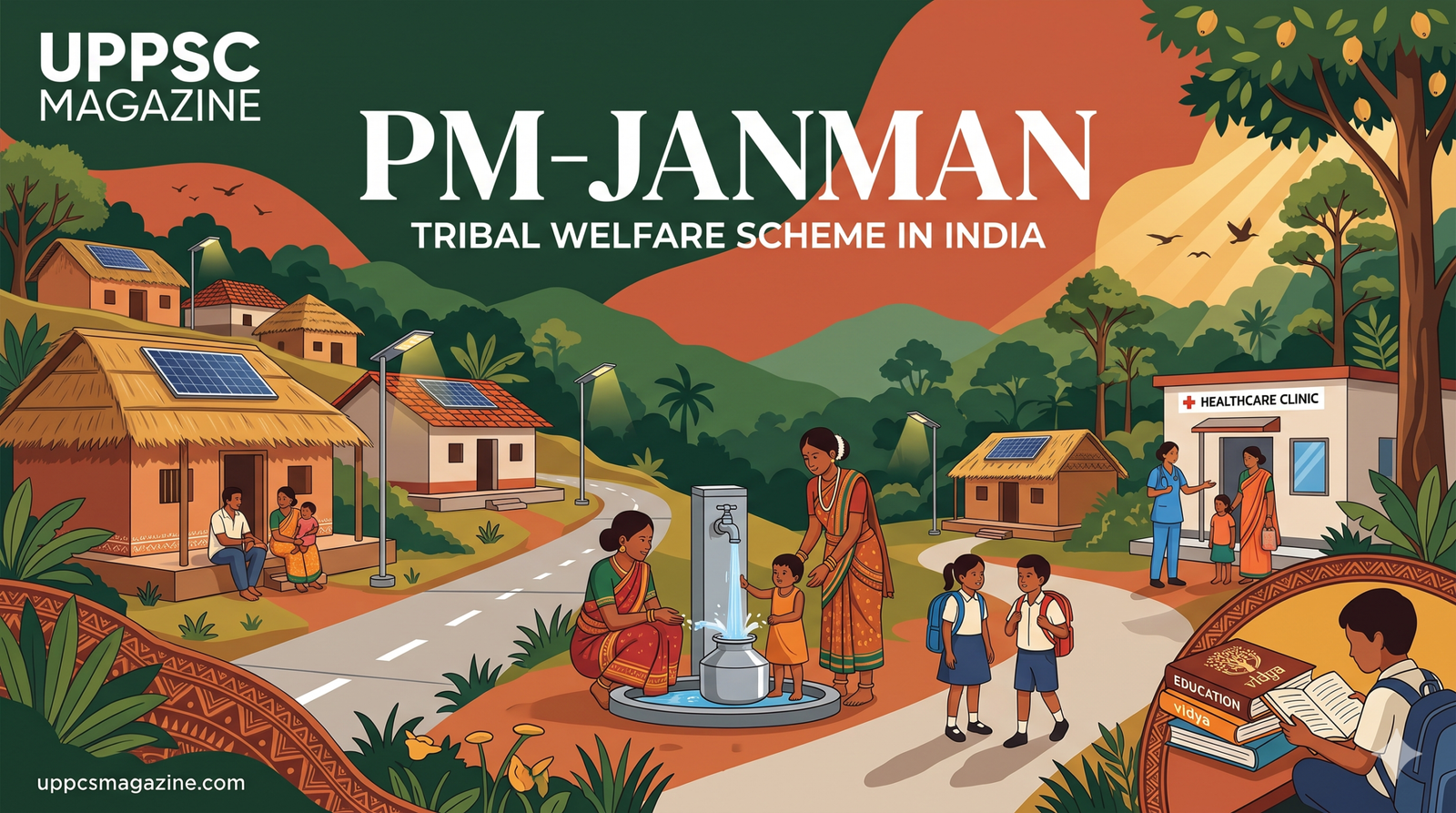
Inclusive development requires reaching the most remote and vulnerable communities first. Among India’s Scheduled Tribes, Particularly Vulnerable Tribal Groups (PVTGs) face acute gaps in housing, clean drinking water, healthcare, education, and road connectivity. To bridge these last-mile deficits, the Government of India launched Pradhan Mantri Janjati Adivasi Nyaya Maha Abhiyan (PM-JANMAN) on 15 November 2023, followed by Dharti Aaba Janjatiya Gram Utkarsh Abhiyan (DA-JGUA) on 2 October 2024.
Background and Constitutional Context
The Constitution of India provides strong safeguards for Scheduled Tribes under Article 15(4), Article 46, Article 275(1), and the Fifth and Sixth Schedules. Despite decades of tribal sub-plans, 75 identified PVTG communities across India remained geographically isolated and underserved.
Core Framework of PM-JANMAN and DA-JGUA
| Scheme | Launch Date & Target Group | Core Focus & Institutional Mechanism |
|---|---|---|
| PM-JANMAN | 15 November 2023; targets 75 PVTG communities | Saturation of 11 critical interventions across 9 ministries, including pucca housing, piped water, all-weather roads, mobile medical units, and 1,000 Multipurpose Centres (MPCs) |
| DA-JGUA | 2 October 2024; targets tribal-majority villages nationwide | Converges 25 interventions across 17 ministries to saturate infrastructure, healthcare, education, and livelihood support |
Key Interventions and Progress 2025–2026
Multi-Ministry Convergence; Multipurpose Centres (1,000 MPCs target); Livelihood and Forest Rights (Van Dhan Vikas Kendras and Forest Rights Act 2006).
Uttar Pradesh Context
Uttar Pradesh is home to significant Scheduled Tribe populations concentrated in Sonbhadra, Ballia, Deoria, Lakhimpur Kheri, Bahraich, and Balrampur (including Tharu, Gond, Kharwar, and Buksa communities). Targeted convergence under DA-JGUA and state tribal welfare schemes improves hostel facilities, Eklavya Model Residential Schools, and forest-based livelihoods.
Challenges and Implementation Gaps
Administrative Coordination across 9–17 ministries; Survey and Beneficiary Identification (uneven state proposals for MPCs); Ecological Sensitivity.
Conclusion
PM-JANMAN and DA-JGUA mark a shift from fragmented tribal welfare to saturation-based, convergence-driven governance.
References
Ministry of Tribal Affairs (PM-JANMAN Guidelines); Press Information Bureau (PIB Parliamentary Releases 2025–2026).