Introduction
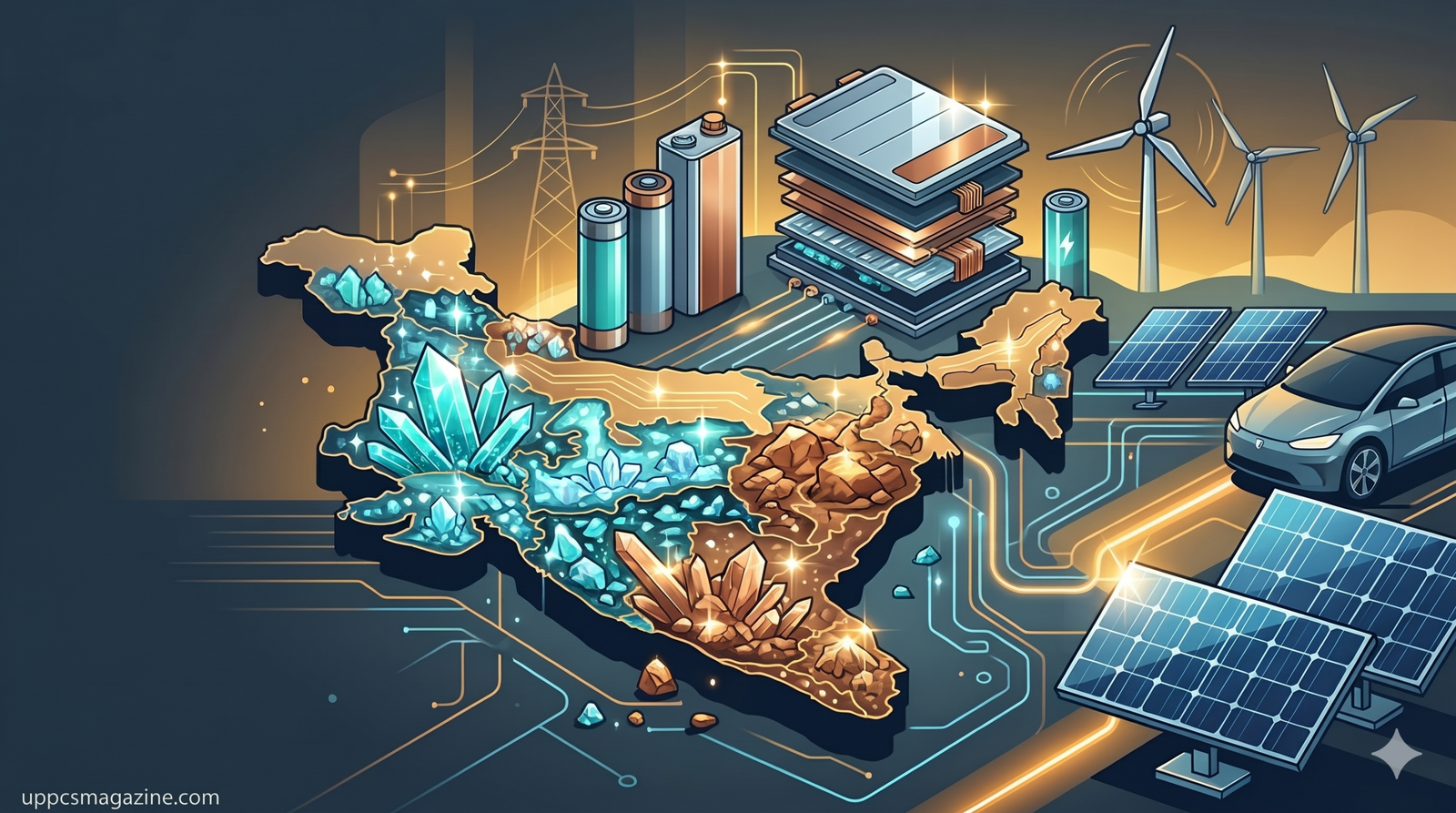
Critical minerals—such as lithium, cobalt, nickel, graphite, and rare earth elements (REEs)—form the industrial backbone of the 21st-century green and digital transition. From electric vehicle (EV) batteries and solar photovoltaic panels to wind turbines, semiconductors, and defense electronics, clean technologies rely heavily on secure access to these mineral inputs. Yet global mining and, even more critically, mineral processing remain concentrated in a handful of countries, exposing import-dependent economies like India to geopolitical supply shocks and price volatility.
To address this strategic vulnerability and support India’s Net Zero by 2070 commitment, the Union Cabinet approved the National Critical Mineral Mission (NCMM) on 29 January 2025. Designed as a seven-year framework from FY 2024-25 to FY 2030-31, the Mission aims to build a resilient, end-to-end domestic and overseas supply chain—spanning exploration, mining, processing, recycling, and research. With the MMDR Amendment Act, 2026 and the CAPEX Support Scheme to Promote Critical Mineral Processing approved in November 2026, critical mineral security has become a high-yield topic across UPSC General Studies Papers 1, 2, and 3.
What Are Critical Minerals and Why Do They Matter to India?
Critical minerals are metallic or non-metallic elements that are essential for economic development and national security, but face high supply-chain disruption risks due to geological scarcity or geopolitical concentration.
In November 2022, an expert committee under the Ministry of Mines identified 30 critical minerals for India, of which 24 minerals were formally placed in Part D of Schedule I of the Mines and Minerals (Development and Regulation) Act, 1957. Key applications include:
- Solar Energy: Silicon, tellurium, indium, and gallium used in photovoltaic cells.
- Wind Energy: Rare earth elements such as dysprosium and neodymium used in permanent-magnet generators.
- Electric Vehicles & Energy Storage: Lithium, nickel, cobalt, manganese, and graphite used in lithium-ion battery cathodes and anodes.
- Defence, Telecom & Electronics: Tungsten, titanium, vanadium, and germanium used in aerospace alloys, radar systems, and microchips.
India imported minerals worth ₹10,12,529 crore in FY 2025-26, underscoring why reducing external dependence on refined intermediates is both an economic and national security imperative.
Core Architecture and Financial Outlay of NCMM
The NCMM is structured as a multi-agency mission with a combined seven-year financial outlay of ₹34,300 crore:
- Central Government Outlay: ₹16,300 crore (including ₹2,600 crore of direct budgetary support up to FY 2030-31).
- Public Sector Undertaking (PSU) Investment: ₹18,000 crore expected from state-owned enterprises across domestic and overseas mineral assets.
Five Pillars of NCMM (2025–2026)
| Pillar | Implementing Agency / Mechanism | Key Progress & Targets |
|---|---|---|
| 1. Domestic Exploration & Auctions | Geological Survey of India (GSI) & National Mineral Exploration and Development Trust (NMEDT) | Targeting 1,200 critical mineral projects; 255 critical mineral projects sanctioned by NMEDT; 64 critical mineral blocks and 11 Exploration Licence blocks auctioned by the Centre. |
| 2. Overseas Asset Acquisition | Khanij Bidesh India Limited (KABIL) & NMEDT (post-2025 amendment) | NMEDT permitted to fund overseas exploration; KABIL secured exclusive lithium exploration rights in Argentina. |
| 3. Domestic Processing Capacity | Union Cabinet CAPEX Support Scheme (Nov 2026) & Critical Mineral Processing Parks (CMPPs) | ₹2,814 crore CAPEX scheme (30% capital subsidy) for 2 Lithium plants (≥30 kt each) & 2 Nickel plants (≥50 kt each); ₹500 crore for CMPPs in Andhra Pradesh, Gujarat, Odisha, and Maharashtra. |
| 4. Secondary Recovery & Recycling | Critical Mineral Recycling Incentive Scheme (launched Oct 2025) | ₹1,500 crore outlay; 58 entities qualified, pledging 850 ktpa recycling capacity from e-waste and spent Li-ion batteries against a 270 ktpa target. |
| 5. R&D & Fiscal Incentives | Centres of Excellence (MAHA Mission) & Union Budget Customs Exemptions | 9 Centres of Excellence named with ₹210 crore funding; Basic Customs Duty (BCD) exempted on critical minerals, Li-ion battery scrap, and processing capital goods. |
Legislative & Policy Milestones: 2025 to 2026
- MMDR Amendment Act, 2026: Modernized India’s mineral governance framework to make deep-seated and critical mineral exploration investor-friendly through Fiscal Predictability (invalidated pending retrospective tax demands and barred arbitrary state levies) and the Exploration Licence (EL) Framework for private junior explorers.
- CAPEX Support Scheme for Processing (November 2026): Approved on 4 November 2026 with a ₹2,814 crore outlay (FY 2026-27 to FY 2030-31), providing a 30% capital subsidy for two Lithium processing plants (≥30 kt each; capped at ₹500 crore per beneficiary) and two Nickel processing plants (≥50 kt each; capped at ₹900 crore per beneficiary).
Key Challenges Ahead
- Long Gestation & Low Discovery-to-Mine Conversion: Deep-seated mineral deposits typically take 7–15 years from initial reconnaissance to commercial extraction.
- Processing & Technology Bottlenecks: Refining battery-grade lithium carbonate, cobalt sulfate, and separated rare earths requires proprietary hydrometallurgical and solvent-extraction technologies.
- Environmental & Social Safeguards: Mining and chemical refining in ecologically sensitive belts demand strict compliance with water-use, tailings-management, and community-consent norms.
- Geopolitical Competition: Global powers—through initiatives such as the US-led Minerals Security Partnership (MSP) and the EU Critical Raw Materials Act—are competing for the same overseas reserves.
Way Forward for India
- Fast-Track Environmental Clearances with Digital Monitoring: Use satellite, LiDAR, and AI-assisted geological mapping alongside transparent EIAs.
- Strengthen Mineral Diplomacy: Leverage India’s membership in the Minerals Security Partnership (MSP) and bilateral agreements (such as KABIL’s partnerships in Argentina and Australia) to secure long-term offtake contracts.
- Scale Urban Mining & Extended Producer Responsibility (EPR): Strictly enforce battery waste and e-waste collection rules so the ₹1,500 crore recycling plants receive steady domestic feedstock.
- Promote Substitution & R&D: Fund the 9 Centres of Excellence to develop sodium-ion batteries, rare-earth-free motors, and low-carbon refining processes.
Conclusion
The National Critical Mineral Mission (NCMM) marks a decisive shift in India’s resource strategy—from passive mineral importing to active value-chain building. By combining exploration reforms under the MMDR Amendment Act, 2026, overseas sourcing via KABIL, circular-economy recycling incentives, and the ₹2,814 crore processing CAPEX scheme, India is laying the industrial foundation for its Net Zero 2070 and Viksit Bharat goals. Sustaining this momentum will depend on rapid technology transfer, environmental accountability, and seamless Centre-State coordination.