Home » Medieval History » Page 2
Indo-Islamic Architecture

Evolution of Indo-Islamic Architecture in Medieval India with Special Focus on Mughal Monuments

Introduction Indo-Islamic architecture represents one of the most significant cultural syntheses in Indian history. It emerged through the interaction between indigenous Indian architectural traditions and Islamic styles brought by Turkish, Afghan, and Persian rulers. This fusion gave rise to a unique architectural idiom characterized by structural innovation, artistic refinement, and cultural integration. The development of…

Read More
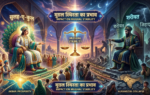
Akbar and Aurangzeb and Their Impact on Mughal Stability

Comparison of Religious Policies of Akbar and Aurangzeb and Their Impact on Mughal Stability

Introduction The religious policies of Mughal rulers played a crucial role in shaping the political and social stability of the empire. Among them, Akbar and Aurangzeb stand out as two contrasting figures. While Akbar is known for his policy of tolerance and inclusiveness, Aurangzeb is often associated with religious orthodoxy. Their differing approaches had profound…

Read More
Vijayanagara Empire

Administrative and Economic Features of the Vijayanagara Empire and Causes of Its Decline

Introduction The Vijayanagara Empire (1336–1646 CE) was one of the most powerful and prosperous empires in medieval South India. Founded by Harihara I and Bukka Raya I, the empire played a crucial role in preserving and promoting Indian culture, economy, and administration during a period of political instability in the Deccan. Its capital, Hampi, was…

Read More
Sher Shah Suri’s Administrative

Sher Shah Suri’s Administrative and Economic Reforms and Their Impact on Mughal Governance

Introduction The reign of Sher Shah Suri (1540–1545 CE), though brief, represents a remarkable phase in the evolution of Indian administration. As the founder of the Sur Empire, Sher Shah introduced a series of administrative and economic reforms that were practical, efficient, and people-oriented. His governance combined strong central authority with systematic organization, laying a…

Read More
Sufi Movement and Cultural Synthesis

Sufi Movement and Cultural Synthesis in Medieval India

Introduction The Sufi Movement played a transformative role in shaping the socio-cultural fabric of medieval India. Sufism, the mystical dimension of Islam, emphasized love, devotion, tolerance, and a direct connection with God. Unlike orthodox religious practices, Sufis focused on inner spirituality rather than rigid rituals. In the context of a diverse and pluralistic society, the…

Read More
Alauddin Khalji Market Reforms

Alauddin Khalji’s Economic Reforms: Nature, Objectives and Effectiveness

Introduction The reign of Alauddin Khalji (1296–1316 CE) is considered one of the most dynamic phases in the history of the Delhi Sultanate. Faced with continuous Mongol invasions, internal rebellions, and the need to maintain a large standing army, Alauddin Khalji introduced a series of far-reaching economic and market reforms. These reforms were not merely…

Read More
Delhi Sultanate Administration

Delhi Sultanate Administration: Structure and Its Distinctiveness

Introduction The administrative system of the Delhi Sultanate (1206–1526 CE) marked a significant transformation in the governance of the Indian subcontinent. Established by Turkish rulers, the Sultanate introduced a centralized, military-oriented, and Islamic-based administrative framework. It combined elements of Persian, Central Asian, and indigenous Indian traditions, creating a unique administrative model. This system not only…

Read More
Architectural Development in the Bundelkhand Region of Uttar Pradesh

Architectural Development in the Bundelkhand Region of Uttar Pradesh

Introduction The Bundelkhand region of Uttar Pradesh holds a distinguished position in the architectural and cultural history of India. Nestled in the southern part of Uttar Pradesh and northern Madhya Pradesh, Bundelkhand encompasses districts such as Jhansi, Lalitpur, Hamirpur, Jalaun, Mahoba, and Banda. This region, marked by rugged terrain and rocky landscapes, is renowned for…

Read More
Architecture in Modern Uttar Pradesh

Development of Architecture in Modern Uttar Pradesh: A Journey from Tradition to Modernity

Introduction The architectural heritage of Uttar Pradesh represents one of the most diverse and continuous traditions in India’s cultural landscape. From ancient Buddhist stupas to medieval Mughal monuments and Nawabi grandeur, the state has served as a cradle of architectural innovation. However, the modern period — roughly from the mid-19th century to the present day…

Read More