Introduction
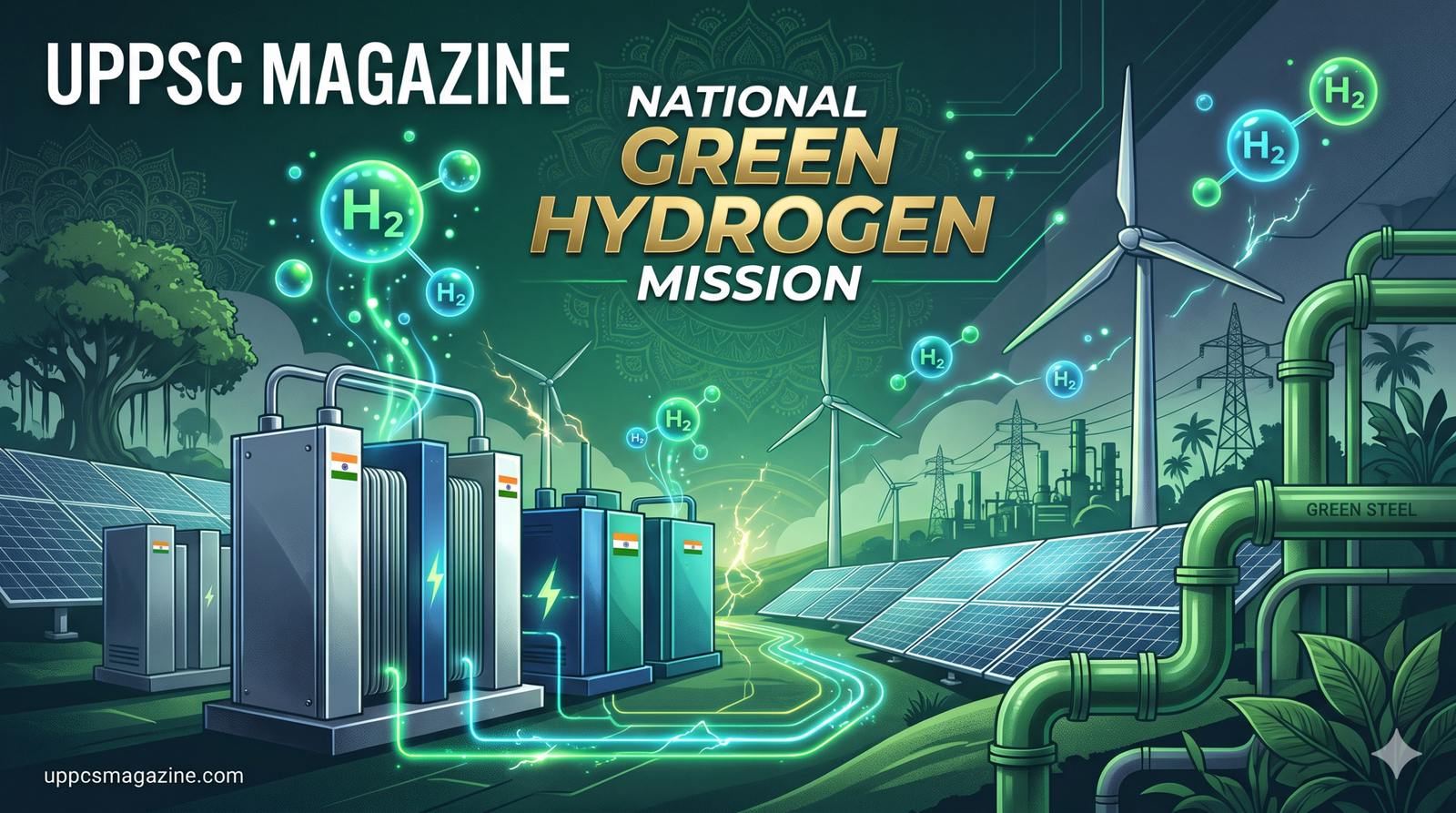
Decarbonizing hard-to-abate industrial sectors—such as steel, fertilizers, oil refining, and heavy transport—requires clean fuels beyond direct electrification. To position India as a global hub for green hydrogen production and export, the Union Cabinet approved the National Green Hydrogen Mission (NGHM) in January 2023 with an initial outlay of ₹19,744 crore.
Core Targets and Institutional Framework 2030 Horizon
Implemented by the Ministry of New and Renewable Energy (MNRE), the mission sets clear quantitative benchmarks for 2030:
- Production Capacity: At least 5 Million Metric Tonnes (MMT) of green hydrogen per annum, backed by ~125 GW of associated renewable energy capacity.
- Emissions & Import Savings: Abatement of nearly 50 MMT of annual greenhouse gas emissions and cumulative reduction in fossil-fuel imports.
- SIGHT Programme: The Strategic Interventions for Green Hydrogen Transition (SIGHT) component provides financial incentives for domestic electrolyzer manufacturing and green hydrogen production.
- Green Hydrogen Hubs: Dedicated clusters near ports and industrial corridors to co-locate production, storage, and export facilities.
Economic Opportunities and Challenges
- Cost Competitiveness: Green hydrogen remains significantly more expensive than grey hydrogen (produced from natural gas), making cheaper renewable power and high-efficiency electrolyzers critical.
- Water and Grid Infrastructure: Producing 1 kg of hydrogen via electrolysis requires ~9 litres of purified water, necessitating careful siting (such as coastal desalination) in water-stressed regions.
- Industrial Demand Creation: Blending green ammonia in fertilizers and piloting hydrogen-based Direct Reduced Iron (DRI) in steel plants will anchor domestic off-take.
Conclusion
The National Green Hydrogen Mission aligns India’s energy security with its 2070 Net Zero commitment. Scaling electrolyzer manufacturing and lowering renewable-power transmission costs will determine how rapidly India captures global clean-fuel export markets.
References
Ministry of New and Renewable Energy (MNRE), Government of India — National Green Hydrogen Mission; Press Information Bureau (PIB) — MNRE Progress Updates.