Introduction
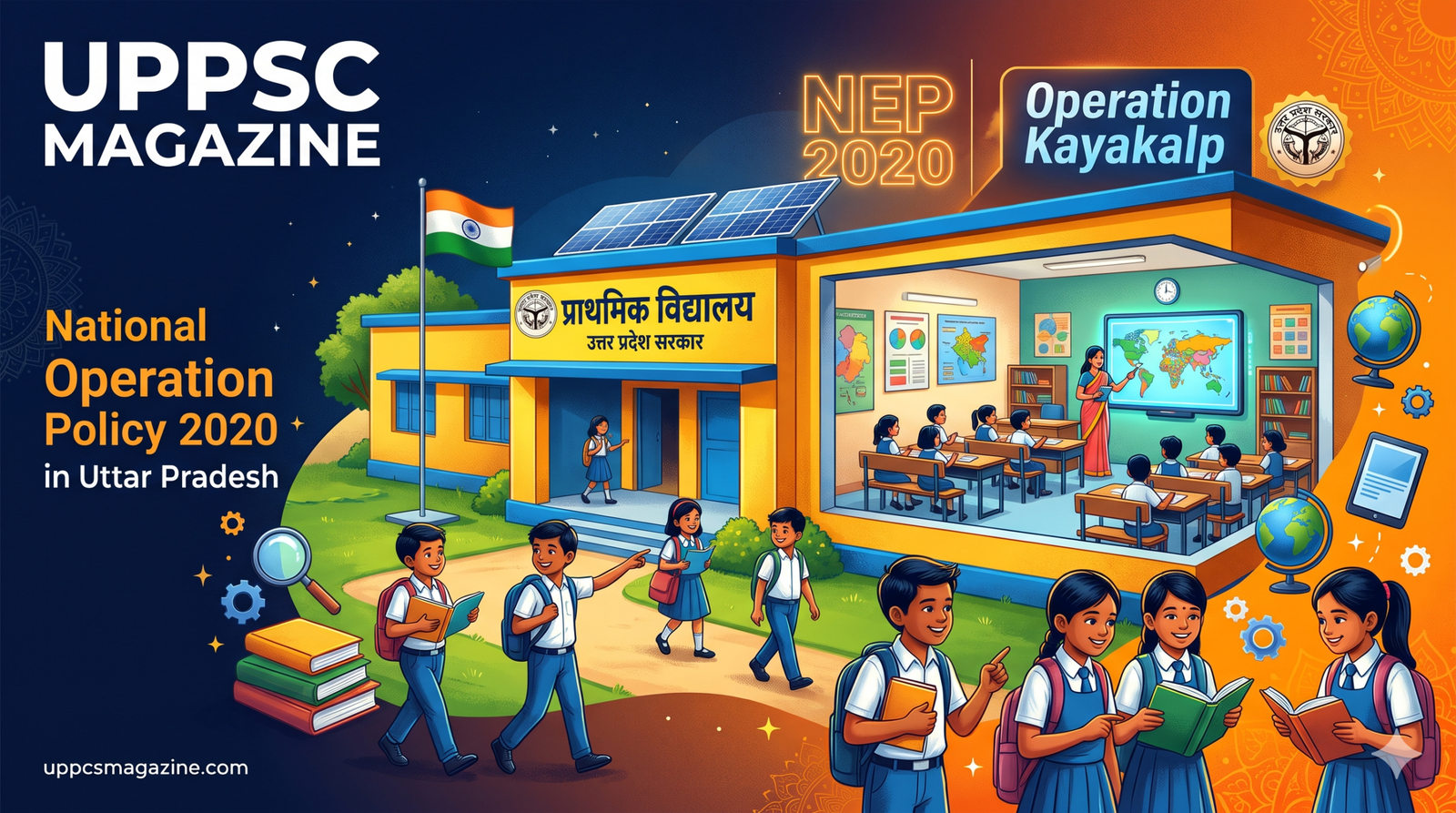
Foundational literacy and equitable school access under the National Education Policy (NEP) 2020 depend heavily on safe, functional school infrastructure. In June 2018, the Government of Uttar Pradesh launched Operation Kayakalp, one of India’s largest inter-departmental convergence programmes, to transform government primary and upper-primary council schools across all 75 districts.
Background and the 19-Point Infrastructure Standard
Historically, many rural government schools lacked basic amenities such as separate toilets, safe drinking water, boundary walls, electricity, and classroom furniture, depressing enrolment and retention—especially among girls and children with disabilities (CWSN). Operation Kayakalp tackled this through a defined 19-point infrastructure standard, covering:
- Safe drinking water and multiple handwashing stations
- Separate functional toilets for boys, girls, and Divyangjan (CWSN-friendly)
- Electrification, fans, lighting, and tiled classroom floors
- Ramps with railings, boundary walls with gates, functional kitchens, libraries, and furniture
Implementation Model and Verified Outcomes
- Inter-Departmental Convergence & Monitoring: The Basic Education Department pooled funds from Samagra Shiksha Abhiyan, Panchayati Raj Institutions (Gram Panchayat funds), and CSR partnerships. Every upgrade is verified through geo-tagged photos and tracked in real time on the Prerna Portal.
- Scale and Saturation: Across roughly 1.33 lakh government council schools serving ~1.66 crore students, the state government reported 97% saturation across the 19 basic parameters by September 2025, with NITI Aayog citing Operation Kayakalp as a replicable national model.
- Project Alankar (Secondary Schools): Extending this model to secondary education, Project Alankar maps 2,295 government secondary schools across 27 parameters—adding smart classrooms, science labs, Wi-Fi, CCTV, and biometric attendance.
Challenges Ahead
- From Infrastructure to Learning Outcomes: Physical saturation must now translate into stronger Foundational Literacy and Numeracy (FLN) under the NIPUN Bharat mission and teacher-training quality.
- Maintenance & Under-Enrolled Schools: Ensuring recurring maintenance of toilets and smart classrooms—and pairing schools with fewer than 50 students with better-equipped nearby campuses—remains an ongoing administrative priority.
Conclusion
Operation Kayakalp shows how decentralized Panchayati Raj funding, clear 19-point benchmarks, and digital geo-tagging can rapidly rebuild public trust in government schooling in Uttar Pradesh.
References
Ministry of Education / Lok Sabha Parliamentary Replies (2025); Mission Prerna, Department of Basic Education, Government of Uttar Pradesh.