Introduction
Uttar Pradesh is India’s leading producer of wheat, sugarcane, and milk, supported by the fertile Indo-Gangetic Plain and diverse physiography. However, rainfall, temperature, and soil characteristics vary sharply from the humid Himalayan foothills in the north to the semi-arid plains in the southwest and the rocky plateau in the south. To plan regional agriculture and irrigation effectively, the Indian Council of Agricultural Research (ICAR) divides the state into nine agro-climatic zones.
Classification of the Nine Agro-Climatic Zones
Rainfall in Uttar Pradesh generally decreases from the wetter north and east toward the drier southwest. Broadly, the nine ICAR zones fall into three ecological belts.
| Agro-Climatic Zone | Key Regions / Districts | Dominant Soil & Rainfall Profile | Major Crops |
|---|---|---|---|
| 1. Bhabhar and Terai | Northern Himalayan foothills along Nepal border | Porous Bhabhar gravel; marshy, clayey-loam Terai; high rainfall | Paddy, sugarcane, wheat |
| 2. Western Plain | Meerut, Baghpat, Muzaffarnagar belt | Deep fertile alluvial soil; high irrigation coverage | Sugarcane, wheat, paddy |
| 3. Mid-Western Plain | Bareilly, Moradabad, Badaun | Fertile alluvial loam; moderate-to-high rainfall | Wheat, sugarcane, paddy |
| 4. South-Western Semi-Arid | Agra, Mathura, Aligarh, Firozabad | Light alluvial / sandy loam; driest zone (~600 mm rainfall) | Mustard, gram, potato, bajra |
| 5. Central Plain | Lucknow, Kanpur, Unnao, Rae Bareli | Deep alluvial soil; well-irrigated canal and tubewell belt | Wheat, paddy, pulses, potato |
| 6. Bundelkhand | Jhansi, Banda, Lalitpur, Hamirpur, Mahoba | Rocky terrain, shallow red and mixed black (Mar/Kabar) soils; erratic rainfall | Millets (jowar, bajra), gram, lentil, sesame |
| 7. North-Eastern Plain | Gorakhpur, Basti, Deoria, Maharajganj | Alluvial soil; high rainfall and flood-prone | Paddy, maize, wheat, sugarcane |
| 8. Eastern Plain | Varanasi, Ayodhya, Azamgarh, Jaunpur | Fertile alluvial soil; dense rural settlement | Rice-wheat system, pulses, vegetables |
| 9. Vindhyan Zone | Mirzapur, Sonbhadra | Plateau terrain with red, stony, and lateritic soils | Coarse cereals, pulses, oilseeds |
Soil Diversity and Regional Contrasts
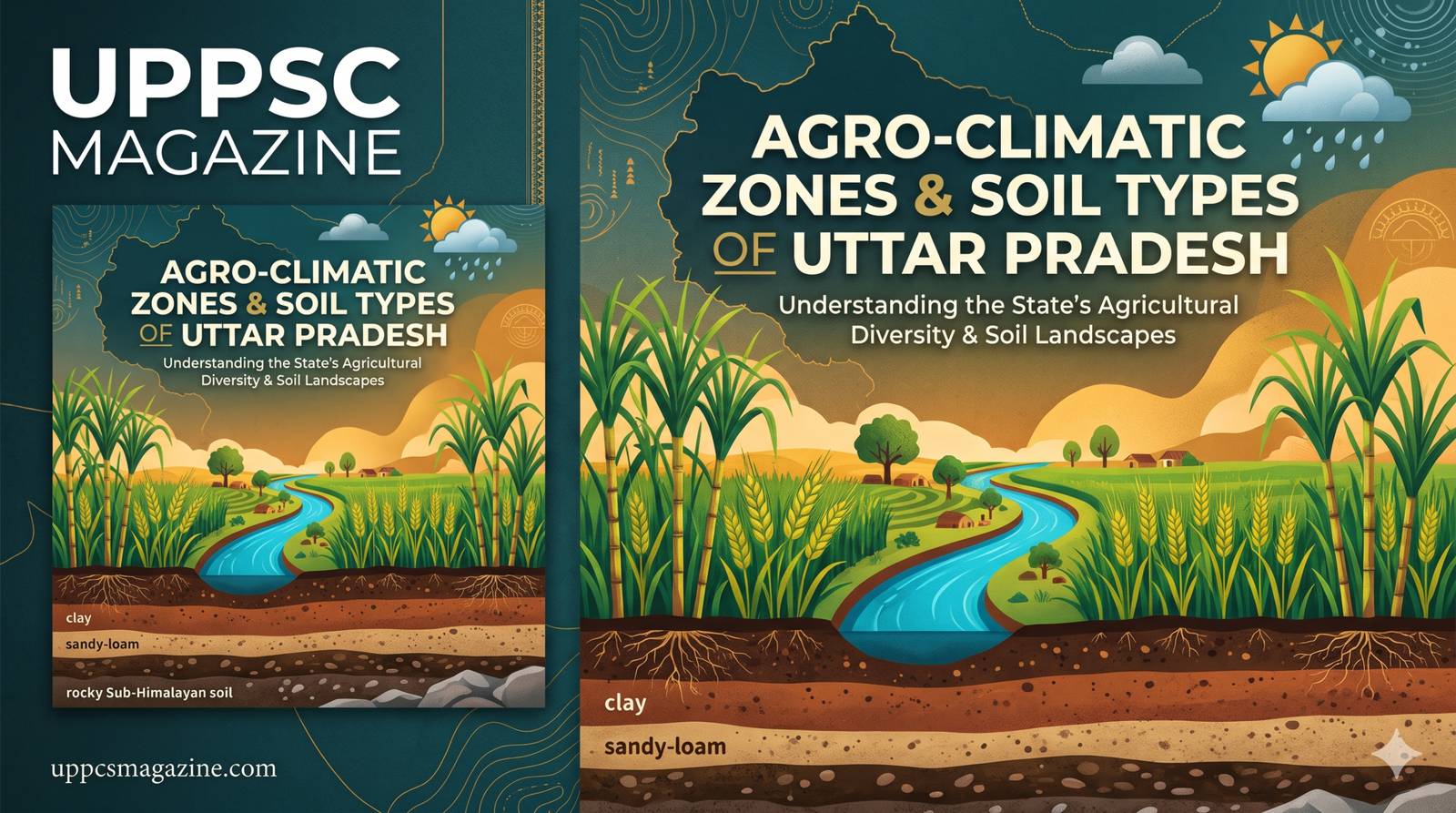
- Alluvial Soils (Khadar and Bangar): Cover the vast Indo-Gangetic Plain; Khadar consists of newer, fertile flood-plain alluvium renewed annually, whereas Bangar comprises older, elevated alluvium often containing calcareous concretions (kankar).
- Terai Clayey-Loam: Found along the northern Himalayan foothills; rich in organic matter and moisture, supporting water-intensive crops such as paddy and sugarcane.
- Bundelkhand and Vindhyan Soils (Parwa, Rakar, Mar, Kabar): Reddish-yellow and stony soils in the southern plateau and Vindhyan uplands, alongside mixed black soils (Mar and Kabar) and light sandy or gravelly variants (Parwa and Rakar) that require moisture-conservation practices.
Challenges and Agricultural Implications
- Groundwater Depletion vs. Floods: Over-extraction of groundwater in the intensively irrigated Western and Central Plains contrasts sharply with recurrent seasonal flooding and waterlogging in the North-Eastern and Terai belts.
- Climate Variability: Erratic monsoons, heatwaves during grain-filling stages, and prolonged dry spells disproportionately threaten rainfed agriculture in Bundelkhand, the South-Western Semi-Arid zone, and the Vindhyan plateau.
- Regional Imbalance: Disparities in canal network density, rural electrification, market access, and crop diversification have created uneven agricultural productivity between western and eastern/southern Uttar Pradesh.
Conclusion
Understanding Uttar Pradesh’s nine agro-climatic zones is fundamental for aligning crop selection, canal irrigation, and climate-resilient farming with local soil and moisture realities. Region-specific diversification—rather than uniform input subsidies—holds the key to sustainable agricultural growth across the state.
References
- Indian Council of Agricultural Research (ICAR) — Agro-Climatic Zones Classification
- Department of Agriculture, Government of Uttar Pradesh