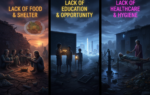
poverty and intergenerational deprivation

Hunger, Poverty and Good Governance in India

Introduction Good governance is not merely about efficient administration or robust institutions; it is ultimately judged by its ability to ensure a dignified life for all citizens. In India, despite decades of planned development and democratic governance, hunger and poverty continue to remain among the most serious challenges to good governance. These problems undermine human…

Read More
Empowerment and Inclusion

Ensuring Empowerment and Inclusion: A Critical Appraisal of the Rights of Persons with Disabilities Act, 2016

Introduction The status of persons with disabilities (PwDs) in any society reflects the depth of its commitment to equality, justice, and human dignity. For long, disability in India was viewed largely through a charity-based or medical lens, resulting in social exclusion, limited access to opportunities, and systemic discrimination. Recognizing the need for a rights-based framework,…

Read More
Outcome-Based Beneficiary Targeting in WASH Schemes

Outcome-Based Beneficiary Targeting in “WASH Schemes”

Introduction Water, Sanitation, and Hygiene (WASH) form the foundation of public health, human dignity, and sustainable development. In a country like India, where population pressure, socio-economic inequality, and environmental stress intersect, WASH interventions are not merely infrastructure projects but instruments of social transformation. Over the years, India has launched several ambitious WASH-related initiatives, including sanitation…

Read More
Strengthening Earn While You Learn for Meaningful Skill Development

Strengthening “Earn While You Learn” for Meaningful Skill Development

Introduction India is at a crucial demographic juncture. With more than 65% of its population below the age of 35, the country possesses what is often described as a demographic dividend. However, this dividend can easily turn into a demographic burden if the youth are not adequately skilled, employable, and economically productive. Despite significant expansion…

Read More
Inequality and Development in India

Inequality and Development in India: Analysis and the Role of Government Welfare Schemes

Introduction Economic development in India over the past few decades has been characterized by high GDP growth, rapid expansion of the service sector, technological advancements, and poverty reduction. However, the persistence of economic inequality poses a serious challenge to sustainable and inclusive development. Inequality is multifaceted, encompassing disparities in income, wealth, education, employment opportunities, and…

Read More
Reducing Inequality and Poverty

Reducing Inequality and Poverty: Pathway to India’s Economic Stability

Introduction Economic development in India over the past three decades has resulted in significant reductions in absolute poverty. According to World Bank data, India’s poverty ratio declined from approximately 45% in the early 1990s to less than 10% by the early 2020s (at national poverty lines). However, the persistence of economic inequality despite high growth…

Read More
Economic Inequality in India

Economic Inequality and India’s Demographic Dividend: Challenges and Pathways to Inclusive Growth

Introduction India is currently experiencing a unique demographic phenomenon: a demographic dividend, characterized by a large working-age population relative to dependents. This demographic structure presents an unparalleled opportunity for accelerated economic growth, productivity enhancement, and global competitiveness. Estimates suggest that by 2030, India will have the largest working-age population in the world, with over 65%…

Read More
Economy Challenges

Economic Inequality in India: Dimensions and the Impact of Regional and Social Disparities on Inclusive Development

Introduction Economic inequality has emerged as one of the most critical challenges facing India in the 21st century. Despite sustained economic growth, technological progress, and rising global integration, the benefits of development have not been distributed evenly across society. Inequality in India is not limited to income differences alone; it spans wealth ownership, access to…

Read More
Welfare Schemes and Redistribution

High Economic Growth in India Has Not Translated into Proportional Reduction in Economic Disparities

Introduction Since the economic liberalisation of 1991, India has emerged as one of the fastest-growing major economies in the world. Market-oriented reforms, integration with the global economy, expansion of the services sector, and technological advancements have enabled India to sustain high GDP growth for extended periods. However, this impressive macroeconomic performance has not been accompanied…

Read More